Curing System Optimization: Kinetics, Energy Efficiency, and Quality Control
The optimization of a curing system begins with the curing kinetics of the coating. The degree of cure (conversion) as a function of time and temperature is described by kinetic models, such as the first-order or nth-order reaction model, or more complex autocatalytic models. For thermal curing, the Arrhenius equation gives the rate constant. For UV curing, the kinetics depend on the photon flux and the photoinitiator concentration. The kinetic parameters are determined by differential scanning calorimetry (DSC) or by isothermal rheometry. The coating supplier usually provides these parameters. The line operator uses them to set the oven temperature and residence time. For example, if the coating requires a minimum of 90% conversion for adequate properties, the combination of temperature and time must achieve that. The residence time is fixed by the line speed and oven length; the temperature is adjusted to meet the conversion target. If the line speed changes, the temperature must be adjusted accordingly; this is done by the control system using a kinetic model. The model calculates the required temperature for the new speed and sends it to the oven's setpoint. This feedforward control ensures consistent cure degree across speed changes. For UV curing, the model uses the UV dose (intensity × time) to predict the cure degree; the lamp power is adjusted to maintain the dose. The kinetic model can also be used to predict the shelf life of the coating, as it cures slowly at ambient temperature.
Energy efficiency in curing systems is achieved by optimizing the thermal profile. For thermal ovens, the heat must be transferred to the coating efficiently; using high-velocity impingement air improves heat transfer but may cause web flutter. The use of IR pre-heaters can raise the coating temperature quickly, reducing the residence time in the convection zones. The oven's exhaust should be minimized to reduce heat loss; however, the removal of volatiles is necessary. Heat recovery systems can capture the waste heat and use it to preheat the incoming air or the fluid. For UV and EB, the energy efficiency is inherently high because the energy is directed at the coating, not the substrate. However, the lamp's electrical efficiency (UV output vs. electricity input) is typically 20-40% for mercury lamps, and 40-50% for LED. The reflectors must be kept clean to maintain efficiency; regular cleaning of lamps and reflectors is a maintenance task. The use of variable-power supplies allows the lamp to be dimmed during idle or low-speed periods, saving energy. In thermal ovens, the insulation quality is critical; an uninsulated oven can lose 30% of its heat. Regular thermal imaging inspection can identify insulation defects. The overall energy consumption of the
curing system should be monitored and benchmarked against best practices; if the consumption is higher than expected, it indicates a problem such as dirty filters, slipping belts, or failed heating elements.
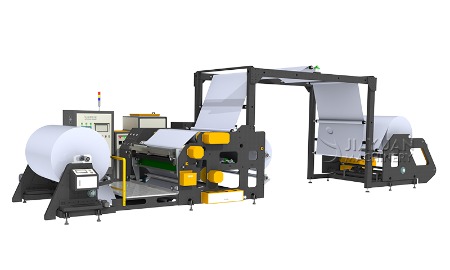
Adhesive coating machine
Quality control of the curing process is essential to ensure that the coating achieves the desired properties. The degree of cure is often measured by off-line tests: solvent resistance (MEK double-rub), hardness (pencil or König pendulum), or adhesion (cross-hatch). For real-time monitoring, inline sensors are available, such as infrared spectroscopy that measures the concentration of unreacted functional groups (e.g., epoxy, isocyanate, acrylate). However, these sensors are expensive and not yet common. A simpler method is to monitor the web temperature at the oven exit; a consistent temperature indicates consistent curing, provided the line speed and coating weight are constant. The control system can use this temperature as a proxy for cure degree, with a correction factor based on periodic off-line tests. If the temperature drops, the oven power is increased. Another method is to use a "cure index" calculated from the kinetic model; the index is updated in real-time based on the temperature profile. If the index falls below the threshold, the line speed is reduced automatically or an alarm is triggered. This predictive approach prevents off-spec production. In practice, many lines operate with a safety margin: a longer residence time or higher temperature than the minimum to ensure complete cure, even if there are minor disturbances. This margin, however, increases energy consumption and may reduce speed. Therefore, an optimal setpoint balances risk and cost.
Common defects related to curing include "under-cure" (tacky, poor solvent resistance, low adhesion), "over-cure" (brittleness, yellowing, poor flexibility), and "cure gradient" (cured on top but uncured at the bottom, causing wrinkling). Under-cure is corrected by increasing the temperature or residence time. Over-cure is fixed by reducing the temperature or time. Cure gradient occurs when the surface is heated too quickly, forming a skin that insulates the lower layers; a slower ramp or using IR with a longer wavelength can improve penetration. For UV curing, "oxygen inhibition" can cause under-cure at the surface; this is mitigated by using a higher photoinitiator concentration or an inert atmosphere (nitrogen purge). For EB, no oxygen inhibition occurs, but high dose can cause surface degradation. Troubleshooting requires a systematic check of the kinetic parameters, the temperature/radiation profile, and the line speed. In summary, curing system optimization is a dynamic process that combines reaction kinetics, heat transfer, energy management, and quality assurance. By leveraging kinetic models, advanced controls, and regular monitoring, coating lines can achieve consistent, high-quality curing with minimal energy waste, ensuring that the final product meets all performance requirements.