Curing Systems for Coating: Thermal, UV, EB, and Moisture Cure Technologies
Curing is distinct from drying; while drying removes solvents, curing involves chemical reactions that build molecular weight and crosslink polymer chains. The result is a thermoset network with enhanced strength, heat resistance, and chemical resistance. The choice of curing system depends on the coating's chemistry. Thermal curing is the most common, used for epoxies, polyesters, acrylics, and polyurethanes. It requires heating the coating to a temperature (typically 80-200°C) for a set time to activate the crosslinking reaction. The time-temperature relationship follows the Arrhenius equation; higher temperatures reduce the required time. Thermal curing ovens are similar to drying ovens, but they may have higher temperatures and longer residence times, and they often include a separate curing section after the drying section. Infrared (IR) curing uses radiant heat to cure the coating quickly, often in seconds; it is used for powder coatings and some liquid coatings. UV curing uses ultraviolet light to initiate photochemical reactions in the presence of photoinitiators. It is extremely fast (curing in milliseconds) and operates at low temperatures, making it ideal for heat-sensitive substrates. Electron beam (EB) curing uses high-energy electrons to generate free radicals, without the need for photoinitiators; it can penetrate thick, pigmented coatings. Moisture cure involves crosslinking with atmospheric moisture; it is used for polyurethane and silicone coatings, and it does not require an oven, but it is slower and humidity-dependent. The selection of a curing system is a strategic decision that affects line speed, energy consumption, capital cost, and product properties.
Thermal curing ovens are designed with multiple zones to provide a controlled temperature profile. The first zone is often used to bring the coating up to the curing temperature, the middle zones maintain the temperature for the required duration, and the final zone cools the web. The curing time is determined by the kinetics: for a typical epoxy, the time at 120°C might be 10 minutes; at 150°C, it could be 2 minutes. The oven length is calculated based on the line speed and the required residence time. The curing process must be monitored; under-curing results in soft, tacky films with poor solvent resistance; over-curing can cause brittleness, yellowing, and degradation. Inline monitoring of cure degree is difficult, but it can be inferred from the web temperature or from off-line testing (e.g., MEK double-rub test). The oven's airflow must be sufficient to remove any volatiles released during curing (e.g., water from condensation reactions). For IR ovens, the power and wavelength must match the coating's absorption spectrum; the distance and focus must be adjustable. IR is often used as a pre-heater before convection to reduce the overall oven length. For UV curing, the system consists of a UV lamp (mercury, metal halide, or LED) and a reflector to focus the light. The UV dose (energy per area) must be sufficient to cure the film; it is controlled by the lamp power and the line speed. LED UV offers longer lamp life and lower heat output but may have lower intensity. For EB, the equipment is more expensive and requires shielding, but it can cure very thick layers and is used in high-speed lines. Moisture cure systems require a controlled humidity environment (typically 30-70% RH) and may take hours to fully cure; they are used for structural adhesives and sealants.
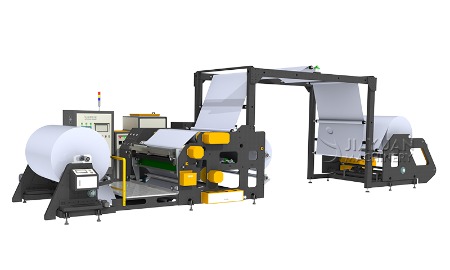
Adhesive coating machine
The
curing system must be integrated with the overall line control. The coating weight, line speed, and substrate temperature all affect the required curing energy. The control system must adjust the oven temperature or UV power in response to speed changes to maintain a consistent cure degree. This is often done with a feedforward loop: when the speed increases, the oven temperature or lamp power is increased proportionally. The system must also have safety interlocks: UV systems require shielding to prevent operator exposure; EB systems require radiation shielding and ozone ventilation; thermal ovens require fire suppression and over-temperature protection. The energy consumption of the curing system is significant; IR and EB are more energy-efficient than convection because they directly heat the coating rather than the air. However, the capital cost of IR and EB is higher. The choice of curing system also affects the coating formulation; for example, UV coatings require photoinitiators, which add cost and may affect stability. Therefore, the curing system selection must consider the entire product lifecycle, from formulation to end-use. In summary, curing systems are essential for transforming a coated liquid into a functional solid. The proper selection and control of the curing system ensure that the final product meets the performance specifications while maximizing production efficiency and minimizing energy use.