Custom Coating Machine: Engineering Tailored Solutions for Unique Coating Applications
A custom coating machine is a bespoke solution designed and built for a unique application—such as a specific adhesive chemistry, an unusual substrate geometry, a very narrow or wide web, an extreme coat weight, or a combination of processes (e.g., coating + laminating + printing). Off-the-shelf machines are optimized for common applications; when the application deviates significantly, a custom machine is necessary to achieve the required quality, speed, and efficiency. The custom design process begins with a detailed feasibility study. The buyer provides the target specifications: substrate type and width, coating fluid properties (viscosity, solids, surface tension), target coat weight and tolerance, line speed, drying/curing requirements, and any special features (e.g., cleanroom compatibility, explosion-proofing, multi-layer coating). The machine builder's engineering team analyzes these requirements, performs lab-scale tests (if needed), and develops a conceptual design. The feasibility study also includes a risk assessment, identifying potential technical challenges and proposing mitigation strategies. The output is a preliminary design and a cost estimate. The buyer must approve the conceptual design before proceeding to detailed engineering. This stage is critical; any changes later in the process are costly and time-consuming. Therefore, the buyer and the machine builder must have open, frequent communication to ensure that all requirements are fully understood and incorporated.
Detailed engineering transforms the conceptual design into a complete set of manufacturing drawings, electrical schematics, and software specifications. The engineering team uses CAD (Computer-Aided Design) software to model the machine in 3D, simulating the web path, the coating head, the oven, and the drive system. Finite Element Analysis (FEA) is used to analyze the mechanical stresses and deflections of the frame and rolls. Computational Fluid Dynamics (CFD) is employed to optimize the die manifold design and the oven's airflow for uniform drying. The electrical design includes the control system architecture, the selection of PLC, HMI, drives, and sensors. The software team develops the control logic and the user interface. The detailed engineering phase also involves the selection of all components: rolls, bearings, motors, heaters, pumps, filters, and sensors. The machine builder should source high-quality components from reputable suppliers to ensure reliability. The buyer should review and approve the detailed design, including the layout drawings, the electrical schematics, and the control philosophy. This review ensures that the machine will fit the available floor space and integrate with the buyer's existing utilities. The engineering phase typically takes 2-6 months, depending on the machine's complexity. A well-executed detailed engineering phase is the foundation of a successful custom machine.
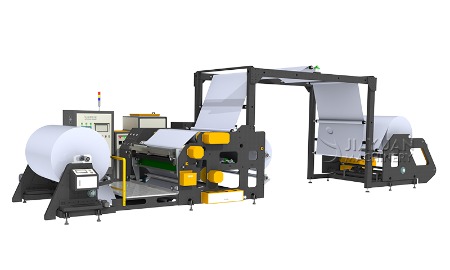
Adhesive coating machine
Manufacturing and assembly of a
custom coating machine require skilled craftsmanship and rigorous quality control. The machine builder's workshop should have the necessary equipment: large CNC machining centers for roll and frame components, welding stations, and assembly bays. The manufacturing process follows the engineering drawings and a quality plan. Key steps include: fabrication of the frame and base, machining of rolls and shafts, assembly of the coating head, installation of the drives and motors, wiring of the electrical panel, and integration of the control system. Throughout the manufacturing process, inspections are performed at critical points: dimensional checks, weld inspections, and electrical continuity tests. The machine builder should also perform a "dry run" of the machine at the factory to test all mechanical movements and electrical functions. After assembly, the machine undergoes a factory acceptance test (FAT) with the buyer's representative present. The FAT verifies that the machine meets the agreed specifications: coating uniformity, coat weight range, speed, and temperature control. The buyer may bring their own materials for the FAT to ensure real-world performance. If the machine passes the FAT, it is then disassembled, packed, and shipped to the buyer's facility. The buyer should also receive a comprehensive documentation package: operation manuals, maintenance guides, electrical schematics, and software backups. In summary, manufacturing and testing are conducted with the same rigor as for any high-precision capital equipment.
Installation and commissioning of a custom machine are critical phases where the machine builder's expertise is essential. The buyer's site must be prepared: the floor must be level and reinforced, utilities (power, air, water, exhaust) must be installed, and the machine's footprint must be clearly marked. The machine builder's installation team supervises the assembly and alignment of the machine, ensuring that all rolls are parallel and the web path is correct. After mechanical installation, the electrical connections are made, and the control system is powered up. The commissioning phase includes: (1) Dry run without coating to check web tracking, tension control, and drive synchronization; (2) Wet run with a surrogate fluid to test the coating head and coat weight control; (3) Production run with the actual coating material to validate the process and to optimize the parameters. The commissioning team also provides on-site training to the buyer's operators and maintenance staff. The training covers machine operation, parameter setting, maintenance procedures, and troubleshooting. The final acceptance test (SAT) is performed at the buyer's site, confirming that the machine meets all performance specifications. The machine builder then hands over the machine, and the buyer formally accepts it. In summary, the installation and commissioning phase is a collaborative effort that ensures the custom machine is fully operational and that the buyer's team is competent to run it.
The benefits of a custom coating machine are significant: (1) It enables the production of unique, high-value products that cannot be made on standard equipment; (2) It can be optimized for specific materials, resulting in higher quality, lower waste, and higher speed; (3) It can integrate multiple processes (e.g., coating, drying, laminating, slitting) into a single line, reducing handling and labor; (4) It can be designed for future upgrades, such as adding a second coating head or a new drying system. However, custom machines have higher upfront cost and longer lead times compared to standard machines. The buyer must also have a clear understanding of their process and be willing to invest time in the design and testing phases. The partnership with the machine builder must be based on mutual trust and technical collaboration. In conclusion, a custom coating machine is a strategic investment for companies that need a competitive edge through unique coating capabilities. By following a structured design, engineering, manufacturing, and commissioning process, the buyer can acquire a tailored solution that delivers superior performance and long-term value.