Diaper Coating: Adhesive Applications, Process Design, and Quality Control in Diaper Manufacturing
Diaper manufacturing relies heavily on adhesive coating to assemble the various components: the nonwoven topsheet, the absorbent core, the backsheet (polyethylene film), and the elastic leg and waist bands. The adhesives used are typically hot-melt, based on styrenic block copolymers, with a formulation that provides the right balance of tack, cohesion, and flexibility. The adhesive is applied at high speeds (up to 600 m/min) on wide webs (up to 4 meters) in a continuous or intermittent pattern. The three main applications are: (1) construction adhesive—used to bond the topsheet and backsheet around the core, typically applied in a wide spiral or slot-die pattern; (2) elastic attachment—used to glue the elastic strands to the backsheet, applied as a narrow bead or slot-die strip; (3) core stabilization—used to spray adhesive onto the absorbent core to hold the superabsorbent polymer (SAP) in place, applied as a fine spray or bead. Each application has different coat weight requirements: construction: 0.5-2 gsm; elastic: 2-5 gsm; core: 1-3 gsm. The adhesive must remain soft and flexible after cooling to maintain the diaper's comfort and fit. It must also be non-toxic, non-irritating, and able to withstand the diaper's environment (heat, moisture, urine). The diaper coating equipment is often integrated into the diaper machine, with separate applicator heads for each adhesive application.
The coating heads used in diaper manufacturing are specialized for high-speed, intermittent operation. For construction bonding, spiral spray nozzles are common; they use a combination of adhesive flow and swirling air to create a helical pattern that provides wide coverage with low grammage. The nozzle design includes an adhesive orifice and air channels; the air pressure and flow rate determine the pattern width and the thread thickness. The nozzle is typically heated to maintain the adhesive temperature. The nozzle must be cleaned regularly to prevent clogging; some systems have automatic cleaning cycles. For elastic attachment, slot-die coating is often used because it provides a precise, straight strip of adhesive. The slot-die gap is set to 0.1-0.3 mm, and the flow rate is controlled by a gear pump. The slot-die is positioned very close to the substrate (1-3 mm) to prevent overspray. The slot-die must be aligned parallel to the elastic strand. For core stabilization, bead application is used; a simple nozzle extrudes a continuous or intermittent bead of adhesive onto the core. The bead diameter is controlled by the pump speed and the nozzle orifice. The bead pattern may be zigzag or straight. All these applicators must have fast response times to start and stop the adhesive flow in sync with the diaper's position (e.g., between diapers). This is achieved by servo-controlled pumps and high-speed valves. The adhesive supply system includes a melter, heated hoses, and filters. The melter must be sized to supply the high flow rates required by multiple applicators. The entire system is controlled by a PLC that synchronizes the applicators with the diaper machine's speed and product cycle.
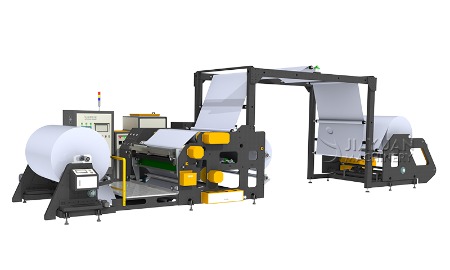
Adhesive coating machine
Quality control in
diaper coating focuses on coat weight, pattern integrity, and bond strength. Coat weight is measured by gravimetric sampling (weighing the adhesive on a known area) or by an online gauge (e.g., beta or optical). For spiral spray, the pattern width and uniformity are checked by a vision system that captures the adhesive pattern; any deviation (e.g., missing spots, excessive threads) triggers an alarm. For slot-die, the strip width and edge straightness are verified. Bond strength is tested by peeling the bonded layers; the force must be within the specification. The adhesive must not bleed through the nonwoven or backsheet; bleed-through is checked by visual inspection. The diaper's softness is assessed by a sensory panel; the adhesive must not stiffen the product. The core stabilization adhesive must hold the SAP in place; this is tested by shaking the diaper and measuring the SAP distribution. The quality data is logged for each production run. If a defect is found, the applicator parameters are adjusted or the applicator is cleaned. The diaper machine often has a reject system that automatically removes defective diapers. The quality control system must be integrated with the production management system to provide real-time feedback. In summary, diaper coating is a critical process that requires precise application of adhesives to ensure the diaper's performance, comfort, and reliability. The equipment must be robust, easy to clean, and capable of high-speed, intermittent operation.