Diaper Coating: Process Optimization, Defect Reduction, and Advances in Adhesive Technology
Optimization of diaper coating starts with the adhesive's application temperature. For typical hot-melt adhesives, the temperature is 140-170°C. The optimal temperature depends on the adhesive's viscosity; a lower viscosity allows finer atomization in spray applications but increases the risk of stringing. The temperature is set based on the supplier's recommendation and verified by testing. The pump speed must be precisely controlled; for intermittent applications, the pump must accelerate from zero to full speed within milliseconds to avoid adhesive tails. This is achieved by using a servo motor with a high torque-to-inertia ratio and a fast controller. The nozzle air pressure for spiral spray is adjusted to achieve the desired pattern width and thread thickness; a higher pressure gives a finer pattern but may cause overspray. The air pressure is typically 0.5-2 bar. The distance between the nozzle and the substrate is set to 10-30 mm; this distance affects the pattern width and the adhesive's temperature upon impact (the adhesive cools as it travels). The slot-die for elastic attachment is set with a gap of 0.1-0.3 mm; the gap must be uniform across the width. The die temperature is kept at the adhesive's application temperature. The bead nozzle for core stabilization has an orifice of 0.2-0.5 mm; the bead diameter is controlled by the flow rate. The optimization is done through a design of experiments (DOE) varying temperature, pressure, flow rate, and speed, and measuring the bond strength, stringing, and pattern coverage. The results are used to set the operating point that minimizes defects and maximizes bond strength. The optimized settings are stored in the product recipe. The control system monitors the parameters and makes automatic adjustments to compensate for variations in adhesive viscosity or ambient temperature.
Defect reduction in diaper coating focuses on stringing, bleed-through, and nozzle clogging. Stringing is the formation of fine adhesive threads that can be felt by the user; it is caused by too high temperature (low viscosity) or excessive air pressure. Reducing the temperature by 5-10°C and adjusting the air pressure can eliminate stringing. The use of a non-stick coating on the nozzle also helps. Bleed-through occurs when the adhesive penetrates the nonwoven or backsheet, causing stiffness or skin contact; it is prevented by using a higher-viscosity adhesive, reducing the coat weight, or applying the adhesive in a pattern that minimizes penetration. The coat weight is the primary factor; it should be kept at the minimum required for the bond strength. Nozzle clogging is due to charred adhesive or dirt; it is prevented by using fine filters (e.g., 100 mesh) in the supply line and by regular cleaning. Some systems have an automatic nozzle purging function that clears the nozzle at the end of each shift. The adhesive melter must be cleaned periodically to remove degraded polymer; the cleaning interval is determined by the manufacturer. The application system should have a "standby" mode that keeps the adhesive at a lower temperature when the line is stopped to prevent charring. The operators are trained to inspect the adhesive pattern and to adjust the parameters if any defect is observed. The quality control system includes inline vision inspection that detects stringing and pattern defects; the defective diapers are automatically rejected. In summary, defect reduction is a continuous effort that combines proper parameter setting, regular maintenance, and automated inspection.
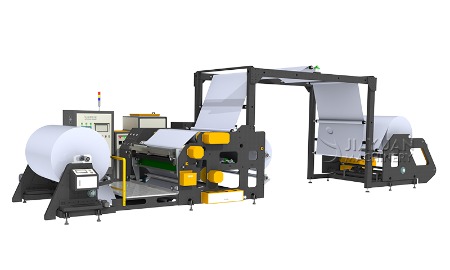
Adhesive coating machine
Advances in adhesive technology are improving
diaper coating efficiency and sustainability. Low-temperature adhesives (applied at 100-130°C) reduce energy consumption and minimize the risk of substrate damage. These adhesives have a lower melt temperature but maintain good bond strength. They require the coating equipment to operate at a lower temperature, which reduces the thermal stress on the nozzles and hoses. Bio-based adhesives, derived from renewable resources, are being developed to replace petroleum-based polymers. These adhesives have a lower carbon footprint and are biodegradable. However, they may have different rheological properties; the coating process must be adapted accordingly. The trend towards thinner, lighter diapers requires lower adhesive coat weights without compromising bond strength; this is achieved by using more efficient application patterns (e.g., micro-fiber spray) and higher-performance adhesives. The use of hot-melt adhesives with low volatile organic compounds (VOCs) is also a priority. The diaper coating equipment suppliers are developing systems that can handle these new adhesives with minimal changeover. The process control systems are being upgraded to provide better temperature and flow control, with faster response times and more accurate sensors. In conclusion, diaper coating is evolving towards higher efficiency, lower environmental impact, and better product performance. By optimizing the process, preventing defects, and adopting advanced adhesive technologies, manufacturers can produce diapers that are softer, more comfortable, and more sustainable, meeting the growing demands of the market and the environment.