Die Gap Adjustment: Principles, Methods, and Impact on Coat Weight and Uniformity
In slot-die coating, the die gap—the distance between the two die lips—is the primary physical parameter that, together with the pump flow rate and line speed, determines the wet coating thickness. The gap is set by the shim thickness, which is inserted between the two die halves. The shim, typically a thin stainless steel foil of precise thickness (e.g., 0.1, 0.2, 0.5 mm), defines the nominal gap. However, the actual gap may vary across the width due to bolt torque variations, thermal expansion, or mechanical wear. The gap directly affects the pressure drop in the die and the coat weight: a larger gap reduces pressure drop and allows higher flow rates, but it may reduce shear and affect leveling. A smaller gap increases pressure and may cause higher shear, which can be beneficial for certain fluids but may lead to excessive pressure and die deflection. The gap must be uniform across the width to achieve a flat thickness profile. Adjusting the gap is done by changing the shim (for coarse adjustments) or by adjusting the die lip bolts (for fine, local adjustments). The lip bolts, along the width, can be tightened or loosened to locally bend the die lip, changing the gap at that point. This is the basis for profile control. The gap is measured at multiple points using a feeler gauge (for static measurement) or a laser displacement sensor (for dynamic measurement). In modern coaters, the gap is set by a motorized mechanism with encoder feedback.
The shim selection is the first step in die gap adjustment. The shim thickness should be chosen based on the target wet thickness and the fluid's viscosity. For low-viscosity fluids (e.g., 1-100 cP), a smaller gap (0.1-0.3 mm) is used to create sufficient shear to stabilize the bead. For high-viscosity fluids (e.g., >10,000 cP), a larger gap (0.5-1.0 mm) is needed to avoid excessive pressure drop. The shim also defines the coating width; it can be cut with tapered ends to reduce edge bead. The shim must be perfectly flat and free of burrs; any irregularity causes non-uniform flow. The shim is replaced periodically; wear or deformation from repeated use can cause thickness variations. The shim should be stored flat and inspected before each use. The die bolts are torqued evenly to a specified value to ensure the die halves are clamped uniformly; uneven torque causes gap distortion. A torque wrench is used, and the bolts are tightened in a cross pattern to distribute the load. After assembly, the gap is verified by inserting a feeler gauge at several points across the width; the feeler gauge should slide with slight resistance. If the gap is not uniform, the lip bolts can be adjusted: tightening a bolt reduces the gap at that location, while loosening increases it. This is a delicate procedure; excessive local adjustment can cause permanent deformation of the die lip.
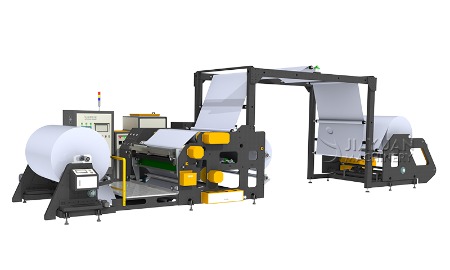
Adhesive coating machine
The effect of die gap on coat weight is not linear; it is influenced by the fluid's rheology. For Newtonian fluids, the coat weight is directly proportional to the gap for a given pump flow and speed. For non-Newtonian fluids, the relationship is more complex; shear-thinning fluids may have a non-linear dependence. Therefore, a calibration curve is necessary: for a given fluid, the gap is varied, and the resulting coat weight (measured by a beta gauge) is plotted. This curve is used to set the gap to achieve the target coat weight at the nominal speed. The calibration should be repeated when the fluid formulation changes. The gap also affects the bead stability: a smaller gap generally improves bead stability but increases the risk of die contact; a larger gap reduces stability but allows a wider coating window. The optimal gap is a compromise that provides stable coating, the target coat weight, and acceptable pressure drop. The gap is often adjusted during startup to achieve the target coat weight; after the process stabilizes, the gap is fine-tuned using feedback from the gauge. In automatic profile control, the gap is adjusted locally using thermal actuators (heater cartridges) that expand or contract the die body; this is done in real-time based on the thickness profile measured by a scanning gauge. This active gap adjustment can correct transverse non-uniformities and edge bead. In summary,
die gap adjustment is a fundamental operation in slot-die coating that requires understanding the fluid's behavior, precise measurement, and careful mechanical tuning to achieve uniform coat weight.