Dry Coat Weight: Definition, Calculation, and Online Determination
Dry coat weight, expressed in grams per square meter (gsm), is the final mass of the coating after drying or curing. It is the mass of the active material—the polymer, resin, pigment, or active ingredient—that remains on the substrate. In contrast, wet coat weight includes the solvents and water that will be removed. The relationship is: dry weight = wet weight × (solids fraction by weight). For example, if a coating fluid is 40% solids and 60% solvent, and the wet coat weight is 100 gsm, the dry coat weight is 40 gsm. The dry weight is what affects the product's performance: adhesive peel strength, electrode capacity, barrier oxygen transmission rate, and optical clarity. Therefore, the product specification always refers to the dry coat weight, with a tolerance band. The coating line's control system must regulate the process to achieve the target dry weight, which requires compensating for changes in the solids fraction. If the solids fraction varies, the pump flow must be adjusted to keep the dry weight constant. For this reason, many lines include an inline densitometer or refractometer to continuously measure the solids content, and the control loop uses this signal to correct the flow. If the solids fraction is not measured, the operator must periodically take a sample, dry it in an oven, and weigh it to recalibrate the wet-to-dry relationship. This off-line method is labor-intensive and introduces delays, so online measurement is preferred for high-speed, high-precision lines.
The measurement of dry coat weight on the fly is typically done by a beta gauge or an X-ray gauge that measures the total mass per unit area (including any remaining solvent). To get the dry weight, the solvent content must be subtracted. This is done by an NIR gauge that measures the moisture or solvent content. The dry weight is then calculated as: dry weight = total mass - solvent mass. This dual-gauge method is common in solvent-based and water-based lines. In hot-melt coatings, where there is no solvent, the total mass measured by the beta gauge is the dry weight directly, because no drying occurs. For UV-curable coatings, the total mass after curing is the dry weight, but the mass of the photoinitiator and any non-volatile components is included. The accuracy of the dry weight measurement depends on the accuracy of both gauges; the combined uncertainty is the root-sum-square of the uncertainties. For a beta gauge with ±0.1 gsm and an NIR gauge with ±0.2 gsm solvent, the dry weight uncertainty is about ±0.22 gsm. This is acceptable for most applications where the target is >10 gsm. For thinner coatings (<5 gsm), the uncertainty becomes significant, and a more precise technique, such as optical interferometry, may be used. Calibration of the NIR gauge is fluid-specific; it requires a set of samples with known solvent content, which are prepared by gravimetric drying in a lab. This calibration is done for each formulation and periodically verified.
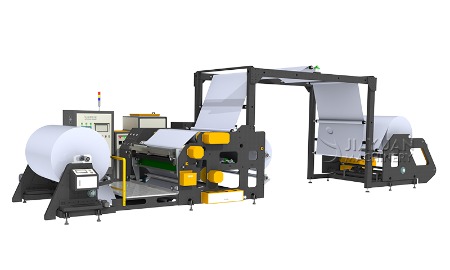
Adhesive coating machine
The solids fraction is a critical variable that must be accurately known. It can change due to: evaporation of solvent from the tank or pan (especially for open systems), batch-to-batch variation in the raw materials, or settling of heavy fillers. A change of just 1% in solids fraction changes the
dry coat weight by 1% if the pump flow is unchanged. Therefore, the solids fraction should be measured at least daily, and preferably continuously. The measurement can be done by a density meter (e.g., a Coriolis meter) that measures the mass density; if the densities of the solids and solvent are known, the solids fraction can be calculated. Alternatively, a refractometer measures the refractive index, which correlates with solids content. The online sensor sends a signal to the control system, which adjusts the pump speed to maintain the target dry weight. For example, if the solids fraction drops from 40% to 39%, the system increases the pump flow by 2.5% to compensate. Without this compensation, the dry weight would drop by 2.5%, causing a quality deviation. In some lines, a "solids correction factor" is entered manually by the operator based on lab results; this is less effective than online measurement but still better than no correction. The trend in solids fraction is also a diagnostic tool: a gradual decrease may indicate solvent evaporation from the tank, prompting the operator to add make-up solvent; a sudden change indicates a batch issue.
The drying process directly affects the final dry coat weight because incomplete drying leaves residual solvent, which adds to the measured total mass and inflates the apparent dry weight. If the drying is incomplete, the beta gauge will read a higher mass than the true dry weight, and the control system may reduce the pump flow, resulting in a lower-than-target true dry weight after the residual solvent is later evaporated. Therefore, it is essential to ensure complete drying. The oven's temperature, airflow, and residence time must be sufficient for the given coating weight and speed. The moisture gauge (NIR) can be used to verify that the residual solvent is below a threshold (e.g., <0.5%). If the residual solvent is consistently high, the line speed must be reduced, or the oven temperature increased. The drying profile should be optimized to avoid skinning, which traps solvent; a multi-zone oven with a gentle first zone is preferred. In some lines, a "post-drying" section with elevated temperature is added to ensure complete removal. The quality control lab will periodically check the dry weight by cutting a sample, drying it in an oven, and weighing it; this is the reference method. If the online gauge's dry weight reading differs from the lab value by more than the allowed tolerance, the gauge calibration or the solids fraction input needs adjustment. This comparison is done daily as part of the quality assurance routine. The lab result is also used to adjust the setpoint for the next run, using a run-to-run control logic.
In summary, dry coat weight is the key performance metric for coated products. Accurate determination requires a combination of online total mass and solvent gauges, precise knowledge of the solids fraction, and complete drying. The control system must integrate all these signals to maintain the dry weight within tight tolerances. The trend towards thinner coatings and higher solids content in sustainable formulations places greater demands on dry weight accuracy. By investing in robust inline sensors, regular calibration, and advanced control algorithms, coating lines can deliver consistent dry coat weight, ensuring that the final product meets its functional requirements and customer expectations. This is a fundamental capability for any modern coating operation, and it is a major differentiator in quality-sensitive markets. Training operators on the principles of dry weight determination and the importance of solids fraction is equally important, as their vigilance and corrective actions are the first line of defense against off-spec production.