Dry Coat Weight: Impact on Product Economics, Thickness Tolerance, and Optimization Strategies
The dry coat weight is the primary driver of material cost in coating operations. For a coating fluid costing $5 per kilogram, a dry coat weight of 20 gsm translates to a material cost of $0.10 per square meter. A reduction of just 1 gsm (5%) saves $0.005 per square meter, which for a line producing 10 million m²/year amounts to $50,000 in annual savings. For expensive coatings, such as optical adhesives costing $50/kg, the saving is $0.50 per square meter for 1 gsm, leading to $500,000 per year. Therefore, even small reductions in dry coat weight have a large economic impact. However, the coat weight cannot be reduced arbitrarily because it must meet the minimum functional requirement. For example, a PSA tape needs at least 15 gsm to provide adequate peel adhesion; below that, the tape fails. Therefore, the optimal dry coat weight is the minimum that consistently meets all performance specifications, given the process's inherent variability. If the process has a high standard deviation, the target must be set higher to avoid going below the minimum at the lower tail of the distribution. This is the essence of the "target setting" problem: target = minimum + (k × σ), where k is a safety factor (typically 3 to 6, depending on the required Cpk). The value of σ determines the material waste; reducing σ allows a lower target and thus lower cost.
The economic optimization of dry coat weight involves a trade-off between material cost and the cost of quality (scrap and rework). If the target is set too low, the risk of producing off-spec (below minimum) increases, leading to scrap that has to be discarded or reworked. The total cost per square meter is: material cost (target × price) + scrap cost (probability of low × price × volume) + rework cost. The probability of low is calculated from the normal distribution using the process mean (target) and standard deviation (σ). As the target is lowered, the probability of low increases, causing a rise in scrap cost. The optimal target is where the marginal saving in material cost equals the marginal increase in scrap cost. For a process with σ = 0.5 gsm, target = 15 gsm, and price = $10/kg, the material cost is $0.15/m². If the target is reduced to 14.5 gsm, material cost drops to $0.145/m² (saving $0.005), but the probability of falling below the minimum (say 14 gsm) may increase from 0.1% to 5%, adding scrap cost. The net effect is calculated to find the optimum. This optimization is done using a spreadsheet or a custom software tool. The data on σ and scrap rates are obtained from the SPC system. The result is a recommended target that minimizes total cost. This target is not fixed; it should be reviewed periodically as the process improves (σ decreases) or as material prices change. This is a dynamic optimization that is part of continuous improvement.
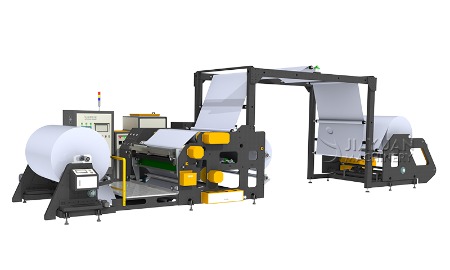
Adhesive coating machine
Strategies for reducing
dry coat weight without sacrificing quality include: improving the coating uniformity (reducing σ) through better mechanical alignment and control; using higher solids content fluids (reducing solvent load and wet thickness); applying a thinner coating but using a more effective additive or binder; and using a primer layer that reduces the required adhesive thickness. For example, in battery electrode coating, increasing the solids content from 50% to 55% allows the same dry weight with a thinner wet film, which reduces drying time and energy, and also allows a slightly lower dry weight because the active material is packed more densely, giving the same capacity. In PSA tapes, using a high-performance polymer that gives higher peel strength at lower thickness can reduce the coat weight by 10-20%. However, these formulation changes must be validated through extensive testing. The process capability can be improved by upgrading the gauge and control system; for instance, replacing a beta gauge with a more accurate gauge or installing active profile control can cut σ in half. The investment in such upgrades is often justified by the material savings over time. The payback period is calculated as the investment cost divided by the annual material saving; a payback of less than 2 years is usually considered acceptable.
Setting the dry coat weight target also depends on the customer's tolerance. If the tolerance is wide (e.g., ±10%), the target can be set closer to the minimum, because the process can operate with a higher σ and still meet spec. If the tolerance is tight (e.g., ±2%), the target must be set higher or the process must be improved to reduce σ. The customer's specification should be negotiated if possible, as a wider tolerance reduces cost. In some cases, the product can be graded: the main product has a tight spec, but off-spec material (slightly lower weight) can be sold as a lower-grade product, reducing scrap. This is common in the tape industry, where "heavy" and "light" products are sold separately. The optimization model can include multiple grades with different prices. Another approach is to use a "reduced target" strategy: for the first few meters of a roll, the target is set higher to ensure good adhesion after the splice, then after the splice, it can be lowered. This is done with a variable setpoint that depends on the position in the roll. Advanced control systems can implement such profiles automatically. In summary, dry coat weight is not only a technical parameter but also a business lever. By combining process improvement, formulation optimization, and intelligent target setting, coating manufacturers can significantly reduce material costs while maintaining product quality, enhancing their competitiveness. This requires close collaboration between process engineers, quality control, and supply chain teams. The result is a "lean" coating operation that minimizes waste and maximizes profit.