Drying Oven Design and Operation for Solvent-Based and Water-Based Coatings
The drying oven is the single most energy-intensive and space-consuming part of a coating line. Its function is to supply heat to evaporate the volatile components (solvents or water) from the wet coating, leaving a solid film. The drying rate is governed by the heat and mass transfer coefficients, which depend on air velocity, temperature, and the vapor concentration gradient. In convection ovens, hot air is blown over the web, transferring heat by convection and carrying away the evaporated solvent. The air velocity is typically 5-20 m/s; higher velocities enhance drying but can cause web flutter. The air temperature is set based on the solvent's boiling point and the substrate's heat tolerance. For solvent-based coatings, the oven must be designed with explosion safety in mind: the air flow must keep the solvent vapor concentration below 25% of the lower explosive limit (LEL). This requires high air turnover rates (e.g., 10-20 air changes per minute) and continuous monitoring of LEL. The exhaust air is passed through a solvent recovery system (carbon adsorption or thermal oxidizer) to remove VOCs before discharge. For water-based coatings, the LEL is not a concern, but the oven must handle high humidity; the exhaust air must be sufficiently dry to maintain the evaporation driving force. The oven is often divided into multiple zones (e.g., 3-7 zones) with independent temperature and airflow control. The first zone is set at a moderate temperature to allow initial evaporation without skinning; subsequent zones increase to drive out the remaining solvent. A final zone may be set lower to cool the web before winding.
The design of the oven must consider the web's path and tension. The web is supported by rollers or air flotation (air bars) to prevent sagging. Air flotation is preferred for thin, delicate webs because it eliminates contact, reducing scratches and dust. The air bars are designed to provide a uniform air cushion across the width, with a slight tilt to guide the web. The oven's length is determined by the required residence time: residence time = oven length / web speed. For a typical solvent-based coating at 200 m/min, the residence time might be 20-60 seconds, requiring an oven 60-200 meters long. To reduce the footprint, some ovens use a zigzag or vertical configuration with multiple passes. Infrared (IR) ovens use radiant heat to directly heat the coating, which can be more efficient and faster than convection, but they are less uniform and can cause hot spots. Many modern ovens combine IR pre-heating with convection zones to achieve rapid drying with good uniformity. The oven's exhaust system must be balanced with the makeup air intake to maintain the desired negative pressure inside the oven, preventing solvent leakage. The exhaust fans are typically variable-speed to adjust airflow based on production speed and solvent load. The oven's control system includes temperature sensors, pressure sensors, and LEL monitors, all interlocked with the line's safety system. If LEL exceeds 25%, the line automatically shuts down and inert gas is purged.
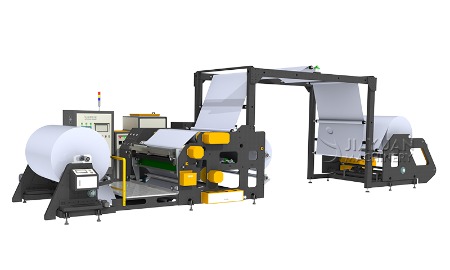
Adhesive coating machine
For solvent-based systems, solvent recovery is mandatory for both environmental compliance and economic reasons. Carbon adsorption systems use activated carbon beds to trap solvent vapors. The beds are regenerated with steam or nitrogen, and the recovered solvent is condensed and decanted for reuse. The efficiency of carbon adsorption is typically 95-99%. Thermal oxidizers combust the VOCs at 700-800°C, releasing heat that can be recovered to preheat the oven air, reducing fuel consumption. The choice between adsorption and oxidation depends on the solvent type, the flow rate, and the local regulations. For water-based systems, no solvent recovery is needed, but the oven exhaust contains water vapor; in some cases, a heat exchanger is used to condense and recover the latent heat. The oven's energy consumption is a major operating cost; using heat recovery wheels or plate heat exchangers can reduce energy usage by 30-50%. The oven's insulation is also critical; poor insulation increases heat loss and energy waste. Regular maintenance includes cleaning the air filters, inspecting the heating elements or burners, checking the belt tension on the fans, and verifying the accuracy of the temperature sensors. The oven's internal surfaces should be cleaned periodically to remove any condensed solvent or dried coating that could be a fire hazard. In summary, the
drying oven is a complex system that integrates heat transfer, fluid dynamics, safety, and environmental controls. Its design and operation must be optimized for each coating formulation and line speed to achieve efficient, safe, and high-quality drying.