Drying Oven: Process Optimization, Defect Prevention, and Energy Efficiency
The drying oven is a common source of coating defects if not properly controlled. "Solvent popping" occurs when trapped solvent vapor expands and bursts through the surface, leaving craters. This is caused by too rapid heating, which creates a skin that seals the surface. The remedy is to use a gentler temperature ramp in the first zone and to ensure sufficient air velocity to remove the solvent vapor from the boundary layer. "Blistering" is similar but results in larger bubbles; it occurs when the substrate or the coating is heated too quickly, causing vapor pressure to build up. Lowering the temperature in the first zone and using a slower web speed can help. "Wrinkling" or "curling" of the web happens when the coating shrinks during drying, creating stresses that deform the substrate. This is mitigated by using a substrate with higher thermal stability, or by drying at a lower temperature to reduce the shrinkage rate. "Web flutter" is caused by high-velocity air impingement, leading to uneven drying and potential web breaks. To reduce flutter, the air velocity should be minimized while still providing adequate drying; using an air flotation oven with a uniform air cushion can also stabilize the web. "Incomplete drying" results in residual solvent, which can cause blocking during winding and reduce adhesion. This is detected by an NIR gauge after the oven; if residual solvent is above the limit, the oven temperature must be increased or the speed reduced. Therefore, the drying profile is a set of interdependent parameters that must be optimized holistically.
The optimization of the drying profile starts with the coating formulation. The solvent's boiling point, the solids content, and the coating thickness determine the amount of energy needed. Using a drying model, the required temperature and airflow can be calculated. The model can be validated by running a trial at several temperature setpoints and measuring the residual solvent and the coating properties. The optimal profile is often a "tapered" profile: low temperature in the first zone (e.g., 40-60°C) to allow slow evaporation and leveling, medium temperature in the middle zones (e.g., 80-100°C) for bulk evaporation, and a high-temperature final zone (e.g., 110-130°C) to drive off the last residual solvent. The number of zones and the length of each zone are fixed by the oven design, but the temperature setpoints can be adjusted. The airflow can also be zoned; higher airflow in the middle zones where the solvent load is highest, and lower airflow near the exit to prevent wrinkling. The web speed sets the residence time; if the speed increases, the temperature must be increased or the airflow increased to maintain the same drying degree. However, increasing temperature may cause skinning; the limit is the substrate's maximum temperature. Therefore, speed increases are often limited by the oven's capacity. In practice, many lines operate below the maximum speed to allow a safety margin.
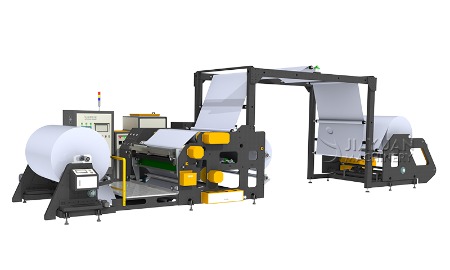
Adhesive coating machine
Energy efficiency in
drying ovens is a major focus. The energy consumption of a convection oven is proportional to the airflow rate, the temperature difference, and the exhaust rate. To reduce energy, the exhaust rate should be minimized while still maintaining the LEL limit (for solvent-based) or the humidity limit (for water-based). This is achieved by using a high-temperature recirculation: a portion of the exhaust air is recirculated back into the oven after being reheated, reducing the amount of fresh air that must be heated. The recirculation ratio can be 70-90%. Heat recovery systems, such as plate heat exchangers or thermal wheels, transfer heat from the exhaust to the incoming fresh air, reducing the heating load. These systems can recover 50-70% of the waste heat. The oven's insulation must be maintained; any gaps or damaged insulation increase heat loss. The use of variable-frequency drives (VFDs) on fans and exhaust blowers allows the airflow to be adjusted to match the production speed, saving energy at lower speeds. The oven's control system should include an energy management module that calculates the energy consumption per square meter and provides a real-time display. Operators can use this data to identify inefficiencies and adjust the settings. For example, if the energy consumption increases while the speed is constant, it may indicate a dirty air filter or a slipping fan belt.
Advanced control systems for drying ovens use model predictive control (MPC) to optimize the temperature and airflow in real-time. The MPC uses a thermal model of the oven and the coating to predict the residual solvent and the web temperature. It then computes the optimal setpoints for the next few minutes, considering the current speed and the coating weight. This allows the oven to respond to speed changes or coating weight changes without overshooting or undershooting. For example, if the line speed increases, the MPC will increase the temperature and airflow preemptively to maintain the drying rate, avoiding a dip in quality. The MPC also coordinates with the solvent recovery system to ensure that the solvent load does not exceed the recovery capacity. The implementation of MPC requires a reliable model and fast computing; it is becoming more common in modern coating lines. In summary, the drying oven is not just a passive heater; it is an active process unit that can be optimized for quality and efficiency. By understanding the drying physics, implementing a zoned temperature profile, using heat recovery, and employing advanced control, coating lines can achieve fast, defect-free drying with minimal energy consumption, making the overall process more sustainable and cost-effective.