Edge Guide: Impact on Coating Margin, Slitting, and Web Wandering Control
The coating margin is the width of coating that extends beyond the final product width, which is later trimmed off. The margin must be large enough to accommodate the web's lateral movement (wander) so that the coating always covers the full product width. If the edge guide is inaccurate, the web may wander significantly, requiring a larger margin. For example, if the web wander is ±2 mm, the margin per side must be at least 2 mm. If the guide can reduce the wander to ±0.5 mm, the margin can be reduced to 0.5 mm, saving material. The margin also includes the edge bead width that must be trimmed. The total margin is the sum of the wander allowance and the edge bead trim. Therefore, improving edge guide accuracy directly reduces waste. The cost of a precise edge guide (e.g., a camera sensor with a fast actuator) can be justified by the material savings. For a line producing 10 million m²/year with a coating cost of $0.10/m², reducing the margin by 1 mm on each side (2 mm total) saves 20,000 m²/year or $2,000/year. This may not seem large, but for expensive coatings, the saving is significant. More importantly, the reduced margin also reduces the substrate waste from trimming.
Web wandering is caused by many factors: roll misalignment, taper on the roll, slippage, or even air currents. The edge guide can compensate for slow wander, but if the wander is too fast (high frequency), the actuator may not be able to follow. The frequency response of the guide is limited by the actuator's speed and the sensor's update rate. If the wander frequency exceeds the guide's bandwidth, the guide cannot correct it, and the web will still move, requiring a margin. Therefore, the guide's performance should be specified to handle the expected wander frequency. The wander can be measured by running the line with the guide turned off and recording the edge position; a spectral analysis shows the frequencies. The guide should have a bandwidth at least 3 times the highest wander frequency. In addition, the web's stiffness affects the wander; a stiffer web (e.g., thick paper) is easier to guide than a flimsy film. The tension also affects the wander; higher tension tends to reduce wander because the web is more taut. The
edge guide should be placed as close as possible to the coating head to minimize the delay between correction and application, but it must be upstream enough to allow the actuator to settle. A distance of 1-2 meters is typical. The guide should also have a "centerline" setting that keeps the web centered on the coating head, not just one edge.
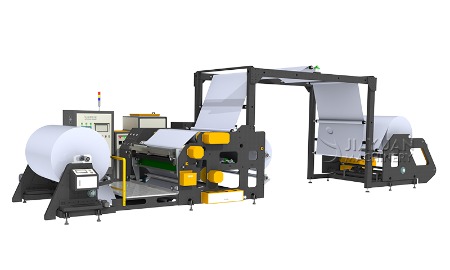
Adhesive coating machine
Slitting accuracy depends on the edge guide's performance. After coating, the master roll is slit into narrower rolls. The slitter knives are positioned based on the web edges; if the web has wandered during coating, the coating pattern may not be centered, and the slitter may cut into the uncoated area or the edge bead. This leads to defective slit rolls. To prevent this, the slitter often has its own edge guide to track the web's position. However, if the coating was applied off-center due to poor upstream guiding, the slitter cannot compensate. Therefore, the coating line's edge guide must maintain the coating centered to the web. The coating margin must also accommodate the slitter's tolerance. If the slitter knives can be positioned with ±0.5 mm accuracy, the margin only needs to cover the wander and the edge bead. In modern lines, the slitter is often integrated with the rewinder, and the slit positions are adjusted automatically based on the web's edge position measured by a camera. This closed-loop slitting ensures that the final rolls have a consistent coating coverage. The edge guide upstream provides the coarse alignment, and the slitter provides the fine alignment.
Practical optimization of edge guide settings: (1) Measure the web wander without guide to determine the required margin; (2) Set the guide's gain to minimize the wander; (3) Use a fast sensor (e.g., camera) and a high-performance actuator for precise control; (4) Place the guide as close as possible to the coating head; (5) Ensure the guide's frame is rigid and free of vibration; (6) Regularly calibrate the sensor and check the actuator's backlash; (7) Monitor the guide's error signal; if the error is consistently in one direction, check the sensor alignment; (8) Adjust the margin based on the actual wander; reduce it gradually to save material, but keep a safety margin. By optimizing the edge guide, the coating line can reduce waste and improve the quality of slit rolls, enhancing customer satisfaction. The edge guide is a relatively low-cost component that yields significant benefits when properly set up and maintained.