Edge Guide Systems: Principles, Sensors, and Actuators for Web Alignment
Edge guides, also known as web guides, are devices that correct the lateral position of the web to ensure it stays centered on the coating head and the rewind/wind sections. Webs can wander due to imperfections in the roll, machine misalignment, or tension variations. If the web is not centered, the coating may be applied off-edge, causing waste; the edges may be coated inconsistently; or the web may run into the machine frame, causing damage or breakage. Edge guides consist of a sensor that detects the web edge's position and an actuator that moves the roll or the entire frame to correct the position. The sensor is typically placed upstream of the coating head, and the actuator moves the roll or frame downstream. A common arrangement is a "steering roll" that pivots about a vertical axis; as it pivots, it shifts the web laterally. Another type is a "displacement" actuator that moves the entire roll assembly laterally. The control system receives the sensor signal and calculates the error between the actual and desired edge position; the error is fed to a PID controller that drives the actuator. The response time must be fast enough to follow web wander, typically 1-5 seconds. The accuracy is typically ±0.5 mm, which is sufficient for most coating applications. For high-precision coating, ±0.1 mm may be required, using a camera sensor.
Edge sensors come in several types. Photoelectric sensors use a light source and a detector; the web edge interrupts the beam, and the amount of light reaching the detector is proportional to the edge position. They are simple and cost-effective, but they can be affected by dust or by changes in web opacity. Ultrasonic sensors emit sound waves and measure the distance to the edge; they are more robust to contamination and are suitable for opaque webs. Camera-based sensors (line-scan or area-scan cameras) provide a high-resolution image of the edge; they can detect the edge with sub-millimeter precision and can also measure the web's width and detect damage. They are more expensive but offer superior performance. The sensor is mounted on a track that allows its position to be adjusted for different web widths. The sensor's output is a voltage or digital signal proportional to the edge position. The sensor must be calibrated: the web is placed at a known position, and the sensor output is adjusted to zero. The calibration is done during setup and verified periodically. The sensor's response time must be compatible with the web speed; for high-speed lines, a faster sensor (e.g., camera with high frame rate) is needed. The sensor is often paired with an edge cleaner to remove dust that could interfere with the measurement.
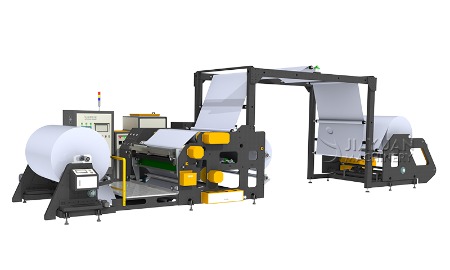
Adhesive coating machine
Actuators for
edge guides include pivoting frames and displacement mechanisms. A pivoting guide uses a roll that is mounted on a pivot; the roll's axis is tilted by an actuator (electric motor or pneumatic cylinder) to steer the web. The tilt angle is small (typically ±5°) but provides sufficient lateral correction. The steering roll is placed after the sensor; the distance between the sensor and the actuator determines the response time. A displacement guide moves the entire roll assembly (e.g., a set of rolls) laterally; this is more powerful but slower. The actuator is controlled by a servo motor or a proportional valve. The control loop uses the error signal; a proportional control gives a fast response but may have residual error; an integral term eliminates the offset. The PID gains are tuned to provide stable control without oscillation. The system also includes a deadband to prevent hunting: if the error is within a small range (e.g., ±0.2 mm), no correction is made. This reduces wear on the actuator. The edge guide may also have a "centerline" mode where it tracks the web's center, not just one edge; this requires two sensors or a sensor that measures the width. The edge guide is often integrated with the line's control system; if the guide fails or the error exceeds a limit, an alarm is triggered and the line may slow down.
Edge guide performance affects coating quality. If the web wanders, the coating may shift, causing the coated width to be inconsistent. For slot-die coating, the die gap is fixed; if the web moves laterally, the coating may be off-center, and the edge bead may be outside the trim area. This can cause waste or defective edges. For gravure coating, the web must be aligned with the engraved pattern; misalignment causes pattern mismatch. For transfer coating, the edge guide ensures that the adhesive is properly aligned with the face stock. Therefore, the edge guide is critical for maintaining product specifications. The edge guide must be maintained: clean the sensor regularly, check the actuator for wear, and verify the calibration. The pivot bearings must be lubricated; worn bearings cause backlash, reducing accuracy. The actuator's drive belt or screw must be checked for tension. The guide's frame must be rigid; any flexing reduces the accuracy. In summary, edge guides are an integral part of the coating line, ensuring the web stays on track. With modern sensors and actuators, they can achieve high precision, minimizing waste and enabling high-quality coating.