Film Coating: Defect Analysis, Quality Assurance, and Advances in Barrier and Optical Coatings
Defects in film coating are often visible to the naked eye and can impair the film's functionality. Streaks are longitudinal lines caused by die lip damage, shim defects, or particle contamination; inspecting and cleaning the die, replacing the shim, and filtering the coating are corrective. Pinholes are small round voids due to bubbles or dust; degassing and cleaning the environment prevent them. Delamination is the separation of the coating from the film; it is caused by low surface energy of the film or contamination; surface treatment (corona, plasma) and cleaning solve this. Orange peel is a rough surface due to poor leveling; reducing the viscosity or adding a leveling agent helps. Bubbles trapped in the coating, called blistering, appear after drying; a slower drying ramp and degassing prevent this. Edge bead (thick edges) is controlled by edge masking or tapered shims. Wrinkling of the film is due to uneven tension; using a spreader roll and proper tension control eliminates it. A systematic approach: identify the defect, check the coating head, the film, the process parameters, and the environment. Use a defect log to track patterns. Preventive maintenance includes regular die cleaning, filter changes, and calibration of sensors. Operators should be trained to inspect the film quality and adjust settings in real-time. In-line vision systems can automatically detect defects and flag or reject defective sections, reducing manual inspection.
Quality assurance for film coating involves a comprehensive set of tests. The coat weight and thickness are measured online and verified by off-line measurements (micrometer, gravimetric). Adhesion is tested by a cross-hatch or tape test; the coating should not peel. Optical clarity is measured by haze and transmittance; the coating must not reduce the film's transparency significantly. For barrier coatings, the oxygen transmission rate (OTR) and water vapor transmission rate (WVTR) are measured using standard permeation testers; the coating must achieve the specified barrier improvement. The coating's abrasion resistance is tested by a Taber abraser; the coating should not scratch easily. The aging resistance is tested by exposing the film to heat, humidity, and UV; the properties should remain within spec. The quality data is analyzed using SPC; any trend indicating a shift in quality triggers an investigation. The process is validated for each product; the validation includes the critical parameters and their acceptable ranges. The documentation is maintained for traceability and regulatory compliance. In summary, quality assurance in
film coating is thorough and ensures that the coated film meets the strict requirements of its end-use application, whether it is a food package, a display screen, or a medical device.
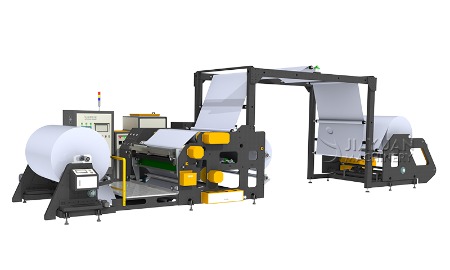
Adhesive coating machine
Advances in film coating are focused on enhancing barrier performance and optical properties. High-barrier coatings, such as nanometer-thick aluminum oxide or silicon oxide, are being applied by plasma-enhanced chemical vapor deposition (PECVD) or atomic layer deposition (ALD), but these are vacuum processes. Liquid-based barrier coatings using nanocomposites (clay or graphene dispersed in polymers) are being developed to achieve high barrier at low coat weights. For optical films, anti-reflective coatings with multiple layers of different refractive indices are applied by slot-die or gravure; these require precise thickness control (within ±10 nm). Hard coatings with nanoparticle fillers provide scratch resistance for touchscreens and lenses. The trend towards thinner, lighter films drives the need for coatings that are both highly functional and thin. Sustainability is also a key driver: water-based coatings are replacing solvent-based, and bio-based polymers are being explored. The coating machine must be flexible to handle these new materials; for example, water-based coatings may require corrosion-resistant parts and modified drying ovens. The integration of advanced sensors and machine learning is enabling real-time optimization of the coating process, reducing waste and improving quality. In conclusion, film coating is an evolving field with continuous improvements in materials and processes, driven by the demand for higher performance and lower environmental impact.