Film Coating: Technologies for Optical Films, Packaging Films, and Functional Coatings
Film coating is a process used to deposit a thin layer of functional material onto a polymer film substrate, such as PET, PP, PE, or polyimide. The coated film finds applications in packaging (barrier films, heat-seal layers), electronics (conductive layers, dielectric coatings), optics (anti-reflective, hard coats), and medical devices (lubricious coatings). The coating thickness can range from sub-micron (for optical layers) to 50 microns (for adhesive layers). The coating must be uniform, defect-free, and well-adhered. The choice of coating method depends on the required thickness, uniformity, and speed. Slot-die coating is widely used for its precision and versatility, handling coat weights from 0.5 to 100 gsm with ±1% uniformity. Gravure coating is used for very thin layers (0.5-5 gsm) at high speeds (up to 400 m/min), especially for primers and release coatings. Roll coating (reverse roll or kiss) is used for thicker coatings (5-50 gsm) on less demanding applications. Vacuum deposition (sputtering, evaporation) is used for metallic and oxide coatings, but these are distinct from liquid coating processes. The film coating line includes an unwinder, a surface treatment station (corona, flame, or primer), the coating head, a drying/curing oven, and a rewinder. The line speed is typically 50-300 m/min; for optical films, it may be slower (10-50 m/min) due to the stringent quality requirements. The web tension must be carefully controlled to avoid stretching the film, which would affect the coating thickness and optical properties.
The coating materials for film coating are diverse and tailored to the application. Acrylics are used for protective hard coats and primers; they are often solvent-based or UV-curable. Polyurethanes are used for flexible, abrasion-resistant coatings; they can be water-based or solvent-based. Silicones are used for release coatings and low-friction layers; they are often solvent-based and require thermal or UV curing. Barrier coatings, such as PVOH, EVOH, and PVDC, are used to reduce oxygen and moisture permeability; they are applied from water or solvent solutions. For optical films, the coating material must have high clarity and a specific refractive index; it may be a polymer or a nanocomposite. The coating liquid is formulated with the appropriate viscosity, surface tension, and solids content to match the coating method. For slot-die, the viscosity can range from 1 to 10,000 cP; for gravure, it is typically 10-100 cP. The coating solution must be filtered to remove particles that could cause defects. The supply system includes a mixing tank, a pump, a degasser, and a filter. The temperature is controlled to maintain consistent viscosity. The coating head must be cleaned regularly to prevent dried residue that causes streaks. The coating line often includes an inline thickness gauge (beta, X-ray, or optical) that provides real-time feedback to the control system. The gauge's signal adjusts the pump speed or the die gap to maintain the target coat weight.
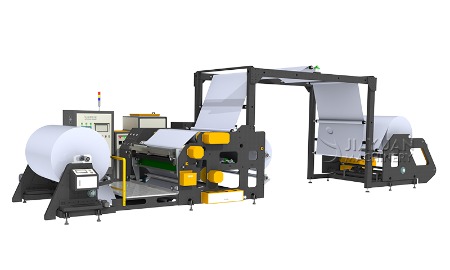
Adhesive coating machine
Process control for
film coating requires precision in several parameters. The coat weight is the primary parameter; it is measured and controlled to within ±1-2% of the target. The drying/curing oven must have a temperature profile that evaporates solvents or cures the coating without damaging the substrate. For solvent-based coatings, the oven must be designed with explosion-proof features and solvent recovery. For UV-curable coatings, a UV lamp bank is installed after the coating head; the UV dose (intensity × time) must be consistent. The web tension must be stable; fluctuations cause thickness variations. The coating head's alignment to the web is critical; misalignment causes cross-web non-uniformity. The environment—temperature, humidity, and cleanliness—must be controlled to prevent defects. For optical films, a cleanroom (Class 100) is required. The machine's control system uses a PLC with HMI; it stores recipes for each product and provides alarms for out-of-spec conditions. The operator can adjust parameters based on the quality data. The coating process is validated for each new product; the validation includes a design of experiments to find the optimal parameter window. In summary, film coating is a highly controlled process that demands advanced equipment, precise measurement, and disciplined operation to achieve the required quality for the demanding applications in packaging, electronics, and optics.