Foil Coating: Processes for Aluminum Foil, Metallized Films, and Barrier Laminates
Foil coating is a specialized process used in the packaging industry to apply thin functional layers onto aluminum foil or metallized polymer films. Foil is widely used for packaging food, pharmaceuticals, and cosmetics because it provides an excellent barrier against oxygen, moisture, light, and aroma. However, bare foil has limited properties: it is not heat-sealable, has low printability, and may be prone to oxidation. Therefore, coatings are applied to enhance its functionality. Common coatings include: protective lacquers (to prevent corrosion and improve appearance), heat-seal coatings (to enable heat sealing of packages), and barrier coatings (to improve gas barrier). The coating thickness is typically 0.5-5 gsm, which is very thin compared to other substrates. The coating must be applied uniformly and without defects, as any pinhole or thin spot will compromise the barrier. The coating machines for foil are similar to those for film coating but require special handling due to the foil's sensitivity to tension and its propensity to wrinkle. The most common coating methods are gravure and slot-die; roll coating is also used for thicker coatings. Gravure is preferred for very thin layers (0.5-2 gsm) due to its precise cell volume control. Slot-die offers excellent uniformity for 2-10 gsm coatings. The line speed for foil coating is typically 100-300 m/min. The substrate width is usually 1-2 meters. The coating line includes an unwinder, a cleaning station (to remove oil and dirt), the coating head, a drying oven (for solvent/water-based coatings), and a rewinder. The drying oven is relatively short (10-20 meters) because the coating is thin. The machine must be designed for quick changeovers, as foil converters often run many different products.
The coating materials for foil are specifically formulated to bond to the foil surface and provide the required properties. Protective lacquers are usually nitrocellulose or acrylic-based, applied from solvent solutions; they are dried rapidly. Heat-seal coatings are based on vinyl, acrylic, or polyester resins; they are activated by heat and pressure during packaging. Barrier coatings, such as PVOH or EVOH, are used to enhance oxygen barrier; they are often water-based. The coating is applied as a liquid and then dried/cured. The coating must have good adhesion to the foil; the foil surface may be cleaned and primed. The viscosity of the coating is typically 10-100 cP for gravure and 50-1000 cP for slot-die. The coating solution must be filtered to remove particles that could cause streaks. The supply system includes a tank, a pump, and a filtration unit. For gravure, the engraved cylinder is selected based on the required cell volume; the doctor blade pressure is adjusted to control the coating weight. For slot-die, the die gap and pump flow set the coat weight. The drying oven is usually a convection oven with impingement air; the temperature is set to evaporate the solvent without damaging the foil (foil can withstand up to 150°C, but the coating may degrade). The oven's exhaust must be controlled to maintain solvent concentration below the LEL. The coated foil is then rewound; a release liner may be applied to prevent blocking. The machine's control system monitors speed, temperature, and tension; the coat weight is measured by a beta gauge or by an NIR sensor that measures the coating thickness. The gauge provides feedback to the pump speed or die gap.
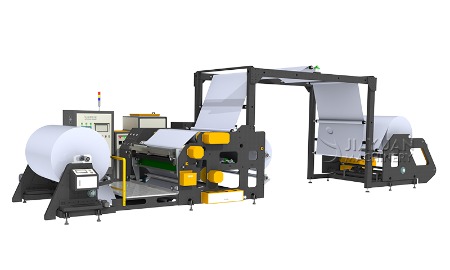
Adhesive coating machine
Quality control for
foil coating is rigorous. The coat weight is measured online; the variation should be within ±5% of the target. The coating's appearance is inspected by a camera system; defects such as streaks, pinholes, and scratches are detected. The adhesion is tested by a tape test (peeling a tape from the coating) or by a cross-hatch test; the coating must not peel off. The heat sealability is tested by sealing the coated foil to another film at a set temperature and pressure, and measuring the seal strength. The barrier properties are tested by measuring the oxygen transmission rate (OTR) or water vapor transmission rate (WVTR) using a permeation analyzer. The coating must achieve the specified barrier level. The coating's resistance to chemicals (acid, alkali, oil) is tested for food packaging applications. The quality data is logged and analyzed using SPC. If a defect is found, the cause is investigated: for example, a low coat weight may be due to a worn gravure cylinder; a streak may be due to a doctor blade nick. The corrective action is implemented and verified. The foil coating line must be validated for each product; the validation includes IQ, OQ, and PQ. In summary, foil coating is a high-precision process that requires accurate control of coating weight, adhesion, and barrier properties to ensure the quality and safety of the final packaged product.