Foil Coating: Troubleshooting Defects, Process Optimization, and Sustainable Solutions
Defects in foil coating can compromise the foil's barrier and appearance. Pinholes are microscopic holes in the coating that allow oxygen or moisture to penetrate; they are caused by air bubbles, dust particles, or poor wetting. To prevent pinholes, the coating solution must be degassed and filtered (down to 5 microns); the foil surface must be clean and have high surface energy. Streaks are linear defects due to a damaged gravure cylinder, a worn doctor blade, or a particle in the slot; inspecting and cleaning the cylinder and blade, and filtering the coating, are corrective. Poor adhesion, where the coating peels off, is due to low surface energy or contamination; corona treatment or applying a primer improves adhesion. Blocking, where the coated foil sticks to itself during rewinding, is caused by incomplete drying or too high coat weight; increasing the oven temperature or reducing the coat weight solves this. Wrinkling of the foil is due to uneven tension; using a dancer roll and proper edge guides prevents wrinkles. Edge bead (thick coating at the edges) is managed by edge masking or by using a slot-die with tapered shims. A systematic troubleshooting method: define the defect, inspect the coating head and the foil surface, check the process parameters (speed, temperature, pressure), verify the coating solution's viscosity and solids content, and test the oven's temperature profile. The corrective action is documented. Preventive maintenance, including regular cleaning of the coating head, replacing the doctor blade, and calibrating the sensors, reduces the occurrence of defects. Operators should be trained to recognize and correct issues early, minimizing waste.
Process optimization for foil coating focuses on coat weight uniformity, drying efficiency, and waste reduction. The coat weight is controlled by the pump speed or the gravure cylinder selection; a feedback loop with the beta gauge adjusts the pump speed. The drying oven's temperature and airflow are optimized to achieve complete drying at the maximum possible speed; the exhaust air's solvent concentration is monitored to maximize the speed without exceeding the LEL limit. The use of a heat recovery system can reduce energy consumption. The coating solution's viscosity is maintained by a temperature controller; a recirculation loop prevents settling. The machine's speed is optimized based on the drying capacity and the coating window. The waste (startup, trim, and off-spec coating) is minimized by using a diverting valve to recycle the startup material; the trim waste is collected and can be reprocessed if the coating is not crosslinked. The machine's changeover time is reduced by using quick-change coating heads and pre-cleaned components. The optimization is an ongoing process, using DOE to find the best parameter combination for each product. The data from the quality control system is used to fine-tune the parameters. In summary, process optimization improves the efficiency and profitability of
foil coating, reducing waste and energy consumption while maintaining high quality.
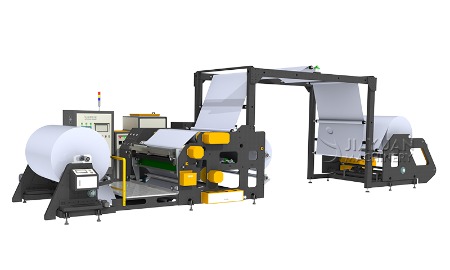
Adhesive coating machine
Sustainability is a major driver in foil coating. Water-based lacquers are replacing solvent-based lacquers to reduce VOC emissions and improve worker safety. Water-based systems require longer drying times, but they are safer and can be recycled. The development of high-solids water-based coatings with faster drying is advancing. The trend towards recyclable foil laminates requires the coating to be compatible with the recycling process; for example, using coatings that can be separated from the foil during pulping. Bio-based barrier coatings made from cellulose or starch are being developed to replace petroleum-based polymers; these are biodegradable and renewable. The use of thinner foil gauges (to save material) requires thinner, higher-performance coatings; this pushes the precision of the coating process. The coating machine must be adaptable to these new materials; for example, water-based coatings may require corrosion-resistant materials and special drying ovens. The integration of inline quality sensors and machine learning for predictive defect detection is improving the sustainability of the process by reducing waste. In conclusion, foil coating is moving towards greener, more sustainable solutions, and the coating industry must innovate to meet these challenges while maintaining the high barrier performance required by modern packaging.