Full Width Coating: Advanced Profile Control, Crown Design, and Width Optimization
Roll crown design is a fundamental method to compensate for roll deflection in roll coating and in slot-die backup rolls. When a roll is under pressure, it deflects (bends) slightly, causing a larger gap at the center than at the edges, which leads to a thicker coating in the center (center thick). To counter this, the roll is crowned—ground with a slightly larger diameter at the center. The crown profile is calculated based on the roll's length, diameter, material, and the expected nip load. The crown is typically parabolic or linear; the required crown height is 0.05-0.3 mm. The crown must be precisely ground; any error causes a non-flat profile. The roll's crown should be checked periodically; if the crown wears down, the profile will drift. In modern lines, the crown is often replaced by active profile control, but for many lines, a well-designed crown is still the most cost-effective solution. In summary, roll crown design is a mechanical approach to profile control that is reliable and maintenance-free.
Active profile control using thermal actuators is the most advanced method for correcting the coating profile in slot-die coating. An array of heater cartridges is embedded in the die body near the lip, spaced every 20-50 mm. Each heater is controlled independently. When a zone is heated, the metal expands, reducing the gap and thus the coat weight in that zone; cooling contracts the metal, increasing the gap and the coat weight. The control system receives the profile from the scanning gauge and calculates the power required for each heater to flatten the profile. The response time is 5-30 seconds, which is sufficient for slow drifts (thermal changes, die wear). The system can also be used to correct edge bead by heating the edge zones. The active profile control can achieve a uniformity of ±0.5% across the width, significantly reducing trim waste. The system requires a robust hardware design and a well-tuned control algorithm. In summary, active profile control is a powerful tool for achieving ultra-uniform coatings.
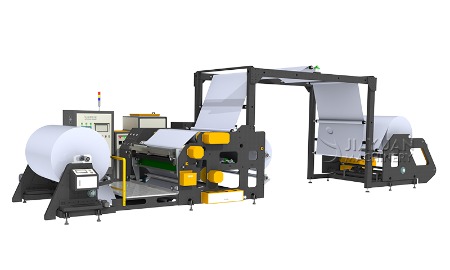
Adhesive coating machine
Piezoelectric actuators offer a faster alternative to thermal actuators. They use piezoelectric crystals that change shape when a voltage is applied; the displacement is small (10-50 µm) but very fast (milliseconds). They are used for high-frequency corrections, such as compensating for roll eccentricity or web thickness variations. However, they are more expensive and have a limited stroke. Some advanced dies use a combination: thermal actuators for slow drift and piezoelectric actuators for fast disturbances. The control system must manage the interaction between the two actuator types. In summary, piezoelectric actuators provide high-speed profile correction for demanding applications.
Width optimization is the economic aspect of
full width coating. The coating width must be slightly larger than the final product width to allow for edge trimming (to remove edge bead) and to accommodate web wander. The extra width is the trim width, which is waste. The goal is to minimize the trim width while still ensuring that the entire product area is coated. The trim width is determined by: (1) the edge bead width; (2) the web wander (measured by the edge guide's performance); (3) the slitter's alignment tolerance. To optimize, the buyer should measure the edge bead width and the web wander, and set the coating width as the product width + 2 × (edge bead width + wander + slitter tolerance). Then, the edge bead reduction techniques are applied to reduce the bead width. The trim width can be reduced from 10-20 mm per side to 2-5 mm per side, saving 2-10% of the coating material. The economic benefit is significant; for a high-volume line, this can save tens of thousands of dollars per year. In summary, width optimization is a continuous improvement activity that reduces waste and increases profitability.
Practical implementation of profile control and width optimization: (1) Measure the coating profile using a scanning gauge; (2) Identify the profile shape (tilt, bow, edge bead); (3) Select the appropriate correction method (crown, active profile, edge vacuum); (4) Implement the correction and verify the profile; (5) Measure the web wander and the edge bead width; (6) Calculate the optimal coating width; (7) Adjust the coating head's width setting and the shim; (8) Monitor the trim waste and the product quality; (9) Document the settings and the results. In conclusion, advanced profile control and width optimization are essential for achieving high-quality, cost-effective full width coating. By investing in these technologies and methodologies, coating lines can produce uniform coatings with minimal waste, enhancing their competitiveness in the market.