Full Width Coating: Principles, Edge Control, and Profile Management for Uniform Coverage
Full width coating, also known as full-web coating, is the standard coating mode where the coating fluid is applied to cover the entire working width of the substrate, typically from 0.5 to 5 meters. The coating must be uniform across the width, with no thick or thin areas, to ensure consistent product properties and to allow efficient slitting. The coating head—slot-die, gravure, or roll—is designed to cover the full width. For slot-die, the die's slot length matches the coating width; the manifold distributes the fluid uniformly. For gravure, the engraved cylinder's pattern covers the full width. For roll coating, the rolls span the full width. The primary challenge is to achieve a flat thickness profile: the variation in coat weight across the width should be within the specified tolerance, typically ±1-2% of the target. The profile is affected by the die gap uniformity, the roll parallelism, the manifold design, and the fluid's rheology. The operator uses an online thickness gauge (beta, X-ray, or optical) to measure the profile and to adjust the coating head to flatten it. In summary, full width coating is the foundation of most converting processes, and achieving a flat profile is the key to quality and yield.
Edge bead is a common defect in full width coating: the coating at the edges is thicker than in the center, often by 10-50%. Edge bead is caused by surface tension pulling the fluid from the edge inward, and by the pressure gradient at the die's edge. Edge bead increases trim waste because the edges must be slit off. Several techniques are used to reduce edge bead: (1) Tapered shims: the shim is cut with a gradual reduction in width at the edges, reducing the slot gap and thus the coat weight locally. (2) Edge vacuum: a vacuum slot at the edges removes excess fluid. (3) Air knives: a jet of air blows off the excess. (4) Edge deckles: movable blocks that physically restrict the flow. (5) Active profile control: using thermal actuators at the edges to adjust the gap. The goal is to reduce the edge bead width to less than 5 mm and the thickness excess to less than 5%. The trim width—the amount removed at each edge—is determined by the edge bead width plus a safety margin for web wander. Reducing the trim width saves material and increases the yield. In summary, edge bead control is a major focus in
full width coating to minimize waste.
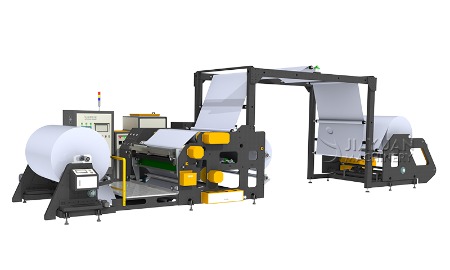
Adhesive coating machine
Profile management is the process of maintaining a flat coating profile across the width. The profile is measured by a scanning gauge that traverses the web; the gauge provides a profile of the coat weight or thickness. The profile can be decomposed into: average level, tilt (linear slope), bow (parabolic curvature), and higher-order variations. Tilt is corrected by adjusting the die's angle or by changing the roll's crown. Bow is corrected by modifying the manifold or by using a profiled shim. Higher-order variations are due to local die lip damage or thermal non-uniformity; active profile control using thermal actuators can correct them. The operator should monitor the profile regularly and make adjustments as needed. The profile data is stored and used for SPC. In summary, profile management is a continuous activity that ensures the coating is uniform across the width, reducing waste and ensuring consistent product quality.
The drying/curing section must also have uniform temperature and airflow across the width to avoid differential drying, which can cause the profile to change due to substrate shrinkage or solvent evaporation gradients. The oven's nozzles and heating elements must be designed for uniform air distribution; thermal imaging can be used to check the temperature uniformity. If the oven has hot spots or dead zones, the coating's final thickness will vary. The operator should check the oven's temperature profile periodically. In summary, the entire line must be designed for width uniformity, not just the coating head.
Troubleshooting full width coating: (1) Center thick: the coating is thicker in the middle. Check for die deflection; increase the die's rigidity or use a crowned die. (2) Edge thick: edge bead; adjust the shim taper, the edge vacuum, or the active profile. (3) Side-to-side variation: the coating is thicker on one side. Check the die's alignment to the backup roll; adjust the angle. (4) Periodic variations: check the roll eccentricity or the drive vibration. A systematic approach using the profile gauge and a gap map is effective. In conclusion, full width coating is the most common and economical coating mode, and its success depends on achieving a flat thickness profile. By understanding the sources of non-uniformity and by using the available edge control and profile management techniques, the coating line can produce high-quality, uniform coatings with minimal trim waste, maximizing yield and profitability.