Gravure Coating Machine: Engraved Cylinder Technology and Coating Uniformity
Gravure coating is a versatile, high-speed coating method that employs a cylinder with a multitude of tiny cells engraved on its surface. The cylinder rotates through a coating pan, filling the cells with fluid. A flexible doctor blade scrapes the excess fluid from the cylinder surface, leaving only the fluid in the cells. The substrate, pressed against the cylinder by an impression roll, contacts the cylinder, and the fluid is transferred from the cells to the web. The coating weight is determined by the cell volume per unit area, the fluid density, and the transfer efficiency (typically 30-80% depending on viscosity and speed). Gravure coaters can operate at speeds up to 600 m/min, making them ideal for large-scale production of release liners, label stock, and packaging films. The engraved cylinder can be chrome-plated or ceramic-coated; ceramic cylinders have longer life and are preferred for abrasive coatings. The cell shape—quadrangular, pyramidal, or hexagonal—affects the release characteristics; hexagonal cells provide the most uniform emptying.
The key parameters of the engraved cylinder are cell volume (measured in cm³/m² or BCM), line count (number of cells per linear inch, typically 60-300), and cell depth. Cell volume directly correlates with the wet coat weight; for a given coating formulation, the dry weight is calculated by multiplying the wet volume by the solids fraction. For example, a cylinder with 10 BCM at 40% solids yields approximately 4 gsm dry. The line count influences the surface smoothness of the coated layer; finer line counts (higher LPI) give smoother films but lower volume. The engraving process is done by mechanical diamond scribing, laser etching, or electromechanical carving. Each method produces different cell profiles. Laser engraving is more precise and allows variable cell depth across the width, enabling profile control to correct coating thickness variations. When selecting a cylinder, the coating's viscosity and particle size must be considered; high-viscosity fluids require larger cell volumes and coarser line counts to prevent starvation.
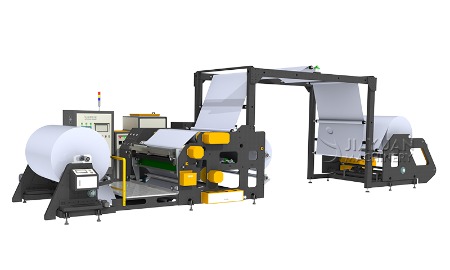
Adhesive coating machine
The doctor blade is critical for controlling the coating weight and quality. It is a steel strip, typically 0.15-0.30 mm thick, pressed against the cylinder surface at an angle (usually 30-60 degrees). The blade pressure, angle, and wear affect how much fluid is removed from the cylinder surface. Excessive pressure can wear the cylinder and produce metallic debris; insufficient pressure leaves a fluid film on the cylinder surface, causing a thick, irregular coating. The blade should be checked daily for wear and replaced when a burr develops. Some systems use a reverse-angle blade for better control with high-speed operations. The blade holder must be aligned parallel to the cylinder axis; any skew causes uneven doctoring, resulting in transverse thickness variation. The material of the blade—standard carbon steel, stainless steel, or plastic—depends on the fluid's corrosivity. For abrasive coatings, ceramic-tipped blades are available. Regular blade replacement is a standard maintenance practice; a set schedule (e.g., every 8 hours of run time) prevents sudden failure and quality issues.
Coating uniformity in gravure is affected by several factors: cylinder runout, impression roll pressure, and web tension. Cylinder runout (eccentricity) causes periodic thickness variation at the cylinder rotation frequency. Runout should be less than 10 µm for precision work; this is achieved by precision grinding and balancing. The impression roll applies pressure to ensure intimate contact between the web and the cylinder; typical pressures are 20-50 N/mm. Uneven pressure across the width leads to inconsistent transfer; the roll must be parallel and have uniform hardness. The impression roll is usually rubber-covered with a Shore A hardness of 80-90. Web tension must be stable to prevent slipping or stretching; dancer rolls and load cells maintain constant tension. Additionally, the coating fluid's temperature and viscosity must be constant; a jacketed pan with temperature control is common. For water-based fluids, defoaming and filtration are critical to prevent bubbles that cause pinholes.
Defects specific to gravure coating include "skipping" (uncoated spots) due to low transfer efficiency or dried cells, "orange peel" from poor flow, and "geometric pattern" from the cell structure showing through the coating. Skipping is addressed by increasing the impression roll pressure or reducing speed; if persistent, the cylinder may need re-engraving. Orange peel is improved by adding leveling agents or reducing viscosity. Geometric pattern is minimized by using a finer line count or applying a smoothing roll (a nip after coating to level the film). Also, "doctor blade streaks" are linear defects caused by nicks in the blade or embedded particles; frequent blade inspection and filtration are preventive. The drying oven after gravure must be matched to the solvent or water load; since gravure applies very thin coatings, drying is faster, which can be an advantage. However, the high speed demands efficient airflow. In summary,
gravure coating machines offer unparalleled precision and speed for thin coatings. With proper cylinder management, blade maintenance, and process control, they deliver consistent, high-quality coatings for a wide array of products, from flexible packaging to electronic materials.