High Speed Coating: Challenges, Equipment Design, and Process Limits for Maximum Productivity
High speed coating is a key productivity driver in the converting industry. Higher line speed directly increases output, reduces unit costs, and improves the return on investment. However, increasing speed amplifies every disturbance and pushes the process to its physical limits. The major challenges are: (1) Air entrainment: at high speeds, the boundary layer of air carried by the substrate becomes thicker and can be entrained into the coating bead, causing pinholes and streaks. The critical speed for air entrainment depends on the fluid's viscosity and surface tension, and the die-to-web gap. To increase the limit, the gap is reduced, the vacuum is increased, or the fluid's surface tension is lowered. (2) Bead stability: the liquid bead in slot-die coating can oscillate or break at high speeds due to hydrodynamic instabilities. The coating window—the range of speeds and flow rates that yield a stable bead—shrinks at high speeds. The die angle, gap, and vacuum must be carefully optimized to extend the window. (3) Drying capacity: the oven must evaporate the solvent at a rate proportional to the speed; the residence time decreases, so the oven must be longer, or the temperature and airflow higher. This often limits the maximum speed. (4) Web handling: at high speeds, tension variations are amplified, and web breaks become more likely. The tension control system must have a high bandwidth, and the web's tensile strength must be sufficient. In summary, high speed coating is a system-level challenge that requires optimization of every component.
Equipment design for high speed coating includes several specialized features. The rolls must be dynamically balanced to avoid vibration; the balancing grade is typically G1.0 or better. The rolls must have high-precision bearings with low friction and high load capacity. The drive motors must have high torque density and a wide speed range; servo motors with direct drive are preferred. The coating head must have a fast-response pump and a precise die gap control; the pump's pulsation must be minimized. The oven must have high-velocity impingement air (up to 50 m/s) to maximize heat transfer; the air must be uniformly distributed across the width. The web tension control system must use load cells with a high sampling rate (e.g., 1 kHz) and fast actuators. The edge guide must have a high bandwidth to correct for lateral wander at high speeds. The control system must have a fast communication bus (e.g., EtherCAT) to synchronize all drives. In summary,
high speed coating requires a purpose-built machine with upgraded components.
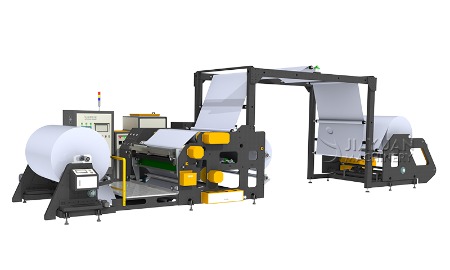
Adhesive coating machine
The coating window at high speeds is a narrow operating region. For a slot-die, the stability limits are: low-flow break (the bead tears), high-flow drip (excess fluid), air entrainment, and hydrodynamic instability (oscillating bead). The window is plotted as a graph of flow rate per unit width (or wet thickness) vs. speed. The upper speed limit is where the window closes. To extend the window, the die gap is reduced, the vacuum is increased, and the die angle is adjusted. The fluid's viscosity and surface tension also affect the window; using a higher-viscosity fluid can extend the window to higher speeds. The operator should map the coating window for each fluid and operate at a point that provides a margin of safety. In summary, operating within the coating window is essential for defect-free high speed coating.
Drying capacity is often the ultimate speed limiter. The required oven length for a given speed and coat weight is: Length = speed × residence time. For a solvent-based coating with a residence time of 30 seconds, a speed of 500 m/min requires an oven of 250 meters, which is impractical. Therefore, high speed lines use impingement air with high velocity to reduce the residence time to 5-15 seconds. They also use IR pre-heaters to rapidly raise the coating's temperature. The oven's exhaust air is controlled to maintain the solvent concentration below the LEL. The drying capacity can be increased by using a higher solids content fluid (reducing the solvent load), but this may affect the coating quality. The buyer should specify the target speed and the coating type to the oven supplier to ensure the oven is sized correctly. In summary, drying is often the bottleneck; advanced drying technologies are essential for high speed coating.
Web handling at high speeds requires stable tension and tracking. The tension control system must have a high bandwidth to reject disturbances from roll runout and motor ripple. A cascade control with a fast inner torque loop and a slower tension loop is common. The use of carbon fiber rolls reduces inertia and improves acceleration. The web's tensile strength must be sufficient to withstand the tension without breaking; the tension setpoint should be below 30% of the web's breaking strength. The edge guide must have a fast actuator and a high-resolution sensor to correct lateral wander. The web's path must be straight; any misalignment causes wrinkles. The operator should monitor the web's tension and speed and adjust the parameters as needed. In summary, robust web handling is critical for high speed operation to avoid breaks and defects. By addressing these challenges with proper equipment design, process optimization, and control, high speed coating can achieve exceptional productivity and quality. The buyer should work closely with the machine supplier to design a high speed line that meets their specific needs, and the operator should be trained to recognize the signs of instability and to adjust the parameters accordingly.