High Speed Coating: Economics, Optimization Strategies, and Future Trends
The economic justification for high speed coating is the reduction in unit cost. As the line speed increases, the fixed costs (depreciation, labor, overhead) are spread over more square meters, lowering the cost per unit. However, the variable costs—material waste, energy, and maintenance—may increase with speed due to higher defect rates and energy consumption. The optimal speed is the one that minimizes the total cost per unit. This is found by a cost model: total cost = (fixed cost / speed) + (variable cost per unit at that speed). The variable cost typically increases at high speeds due to more scrap and higher energy. The optimal speed is where the marginal benefit of increased output equals the marginal cost of increased waste and energy. The buyer should conduct a speed-ramp test, measuring the defect rate and the energy consumption at each speed, and then use the cost model to find the optimum. In many cases, the optimal speed is 80-90% of the maximum technical speed, providing a balance between productivity and quality. In summary, high speed coating is economically attractive, but the optimal speed must be determined by a cost-benefit analysis.
Optimization strategies for high speed coating include: (1) Reducing the coat weight: a thinner coating requires less drying, allowing higher speeds. (2) Using a higher solids content fluid: less solvent to evaporate. (3) Improving the bead stability: adjusting the die gap, vacuum, and angle. (4) Upgrading the oven: using impingement air, IR pre-heaters, and heat recovery. (5) Using a faster-curing adhesive: UV or EB curing. (6) Reducing the web tension to allow higher speed without breaking. (7) Upgrading the control system to a faster PLC and a high-speed network. (8) Implementing predictive maintenance to reduce unplanned downtime. Each optimization step should be evaluated for its cost and benefit. In summary, a systematic optimization approach can increase the line speed by 20-50% without a major capital investment.
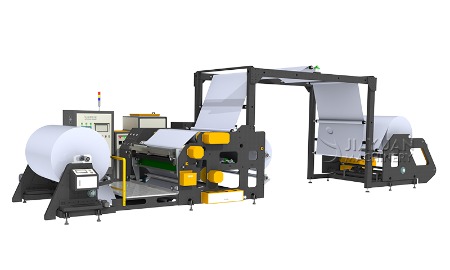
Adhesive coating machine
Energy cost is a significant factor in
high speed coating. The drying oven consumes a large amount of energy; at higher speeds, more energy is needed to evaporate the solvent in a shorter time. The energy consumption per unit area may increase at high speeds, reducing the net benefit. To mitigate this, the buyer should use heat recovery systems, better insulation, and energy-efficient burners. The use of LED UV curing can reduce energy consumption compared to thermal curing. The buyer should also consider the cost of electricity and gas; in regions with high energy prices, the optimal speed may be lower. In summary, energy cost is a key variable in the economic optimization of line speed.
Industry 4.0 technologies enable higher speeds by providing real-time data and predictive analytics. Smart sensors monitor the coating bead, the web tension, and the coat weight; the data is used by machine learning algorithms to predict instabilities and to adjust parameters proactively. For example, if the bead shows early signs of oscillation, the control system can increase the vacuum or adjust the pump speed before a defect occurs. Predictive maintenance uses vibration and temperature data to forecast bearing wear or motor failure, preventing unplanned downtime that would interrupt high-speed operation. The integration of the line with the plant's MES allows for real-time tracking of productivity and quality, enabling rapid decision-making. In summary, Industry 4.0 technologies are essential for achieving and sustaining high speeds.
Future trends in high speed coating include the development of ultra-fast curing systems, such as EB curing and high-intensity LED UV, which can cure coatings in milliseconds, removing the drying bottleneck. The use of smart, self-optimizing dies with integrated sensors and actuators will allow the coating head to adapt to speed changes instantly. The development of new, low-viscosity, high-solids coatings will reduce the drying load. The trend towards wider webs (up to 5 meters) will increase the output per pass. The use of digital twins for off-line optimization will allow operators to test new speed settings without risk. In conclusion, high speed coating is a dynamic field with continuous improvements in technology and methodology. By embracing these advancements, coating manufacturers can achieve ever-higher speeds, lower costs, and better quality, maintaining their competitive edge in the global market. The key is to invest in the right equipment, adopt a data-driven optimization approach, and train the workforce to operate and maintain the high-speed line effectively.