High Viscosity Coating: Pumping, Die Design, and Process Challenges for Thick Pastes and Adhesives
High viscosity coating is a demanding process that handles fluids with thick, paste-like rheology. These fluids are used in battery electrode production (slurries of active materials, carbon black, and binder), hot-melt adhesives (rubber-based or polyurethane), sealants, and heavy-duty protective coatings. The high viscosity imposes significant pressure drops in the fluid delivery system and the coating head. The key challenges are: (1) Achieving a uniform flow rate without pulsation; (2) Preventing air entrapment; (3) Ensuring complete wetting of the substrate; (4) Maintaining a stable coating bead; (5) Avoiding excessive shear that could degrade the fluid's properties. The equipment must be designed with robust pumps, heated or jacketed components (to reduce viscosity by increasing temperature), and large internal channels to minimize pressure drop. The coating head, typically a slot-die or a comma coater, must have a wider gap (0.5-2 mm) and a longer land length to develop the required pressure. The line speed is generally lower (10-100 m/min) to allow the fluid to flow and to provide sufficient drying or cooling time. In summary, high viscosity coating is a specialized field that requires a deep understanding of rheology and equipment design.
Pumping high-viscosity fluids is the first challenge. Centrifugal pumps are ineffective; positive displacement pumps are required. Gear pumps are the most common, using two meshing gears to displace the fluid; they provide a smooth, pulse-free flow if properly designed with tight clearances. For extremely high viscosities (>100,000 cP), screw pumps (progressive cavity) or piston pumps are used. The pump must be driven by a high-torque motor with a servo drive for precise speed control. The suction line must be short and have a large diameter to prevent cavitation; the fluid is often supplied by a "flooded" head from a tank above the pump. The pump is heated (for hot-melts) or cooled (to maintain temperature stability). A pressure sensor at the pump outlet monitors the pressure; a sudden increase indicates a clogged filter or a viscosity change. A pulse dampener is essential to smooth out any residual pulsation. In summary, the pump system must be robust and matched to the fluid's viscosity.
Die design for
high viscosity coating requires a larger slot gap to reduce the pressure drop. The slot gap is typically 0.5-2.0 mm, compared to 0.1-0.3 mm for low-viscosity fluids. The land length (the parallel section of the slot) is shorter to reduce resistance. The manifold must have a large cross-section to distribute the flow evenly; a "coat-hanger" manifold with a tapered channel is common. The die body must be rigid to withstand the high internal pressure (up to 200 bar) without deflecting. The die is often heated (for hot-melts) to reduce the fluid's viscosity; the temperature is controlled within ±1°C. The die lip must be robust to resist wear from abrasive fillers. The die-to-web gap is also larger, typically 0.2-1 mm, to allow the fluid to flow without excessive shear. In summary, the die geometry is designed to minimize pressure drop and to provide a stable, uniform flow.
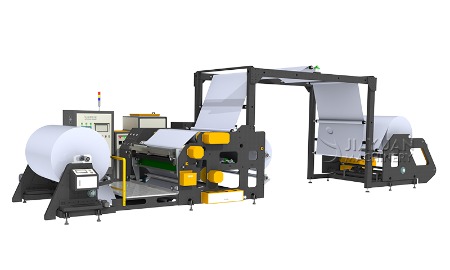
Adhesive coating machine
Process control for high viscosity coating focuses on pressure and temperature. The pressure at the die inlet is a key indicator of the process; a drop in pressure may indicate a leak or a pump issue; a rise may indicate a clogged filter or a viscosity increase. The temperature is critical because viscosity is highly temperature-sensitive; a 5°C change can change the viscosity by 20-30%. The temperature is controlled by jacketed tanks, heated hoses, and heated dies. The flow rate is controlled by the pump speed; a feedforward loop from the line speed adjusts the pump speed proportionally. A feedback loop from the coat weight gauge corrects any errors. The coating bead is visually monitored; for high-viscosity fluids, the bead is thick and stable, but it may be susceptible to air entrainment. A vacuum box may be used, but it is less effective than for low-viscosity fluids. In summary, the process control system must be tuned to the fluid's slow response and high inertia.
Defects in high viscosity coating include: (1) Streaks from die lip damage or particle contamination; (2) Air entrainment, visible as pinholes; (3) Uneven coat weight due to pressure fluctuations; (4) Edge bead, which is often more pronounced due to high surface tension; (5) Incomplete wetting of the substrate if the fluid's viscosity is too high. To prevent these, the fluid should be degassed and filtered (using coarser filters to avoid excessive pressure drop), the die gap should be optimized, and the substrate should be pre-heated or corona-treated. The operator should use a high-pressure gauge and a visual inspection system to monitor the process. In conclusion, high viscosity coating is a challenging but essential process for many industries. By designing the equipment for the specific fluid, controlling the temperature and pressure, and maintaining a clean system, manufacturers can achieve consistent, high-quality coatings even with the thickest materials.