High Viscosity Coating: Rheology, Temperature Control, and Advanced Application Techniques
High-viscosity coating fluids often exhibit non-Newtonian behavior, such as shear-thinning (viscosity decreases with increasing shear rate), yield stress (a minimum stress required to initiate flow), and thixotropy (time-dependent viscosity). These properties significantly affect the coating process. Shear-thinning is beneficial: at the high shear rates in the die slot and the bead, the fluid flows easily; after application, the shear rate drops, and the viscosity increases, preventing sagging and improving leveling. Yield stress fluids, like many battery slurries, require a certain pressure to start flowing; this affects the pump's startup behavior. Thixotropic fluids may have a different viscosity depending on the shear history; the pump and the die must provide a consistent shear history to maintain a constant coat weight. Understanding these rheological properties is essential for selecting the right pump, die, and operating parameters. The buyer should have the fluid characterized by a rheometer; the data is used in the die design and the control system. In summary, rheology is the key to successful high-viscosity coating.
Temperature control is critical for high-viscosity fluids because viscosity decreases exponentially with temperature. A 10°C increase can halve the viscosity, reducing the pressure drop and allowing higher speeds. However, excessive temperature can degrade the fluid (e.g., thermal degradation of polymers, evaporation of solvents). Therefore, the temperature is controlled within a narrow window, typically ±1-2°C. The tank, hoses, pump, and die are all jacketed or heated with cartridge heaters. The temperature is measured by RTDs at multiple points; the control system uses PID controllers to maintain the setpoints. The heating rate must be controlled to avoid thermal shock. The cooling rate after coating (for hot-melts) is also important; rapid cooling can cause crystallization or brittleness. In summary, precise temperature control is the key to managing viscosity and ensuring consistent coating quality.
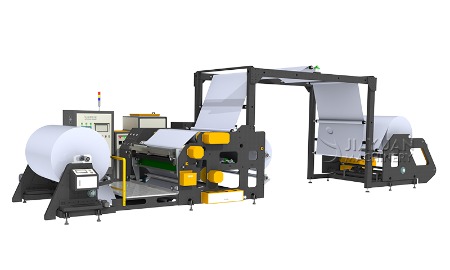
Adhesive coating machine
Advanced application techniques for high-viscosity fluids include: (1) Heated slot-dies: the die is heated to maintain the fluid's temperature right up to the lip, preventing a viscosity increase. The heaters are zoned to ensure uniform temperature across the width. (2) Extrusion coating: a screw extruder is used to melt and pump the fluid; the extruder's screw design must match the fluid's rheology. This is common for hot-melt adhesives and some polymers. (3) Comma coater: a knife-over-roll coater where a heavy-duty blade (comma roll) meters the fluid; the comma roll is heated or cooled. This method is used for very high-viscosity pastes (e.g., 500,000 cP) and for thick coatings (>100 gsm). The comma coater has a large gap and a robust frame to withstand the high loads. (4) Slot-die with a heated shim: the shim is heated to reduce the viscosity at the edges. These techniques enable the coating of materials that would be impossible with standard equipment. In summary, the choice of technique depends on the fluid's viscosity, the required coat weight, and the line speed.
Case Study 1: Battery Electrode Slurry. A typical anode slurry has a viscosity of 10,000-50,000 cP and is shear-thinning. The coating is performed using a comma coater or a slot-die with a wide gap (0.5-1 mm). The fluid is pumped by a gear pump, and the temperature is controlled at 25-30°C. The coat weight is 100-200 gsm. The main challenges are preventing agglomerates (using filtration) and achieving edge bead control (using edge dams). Case Study 2: Hot-Melt Adhesive. A rubber-based hot-melt has a viscosity of 5,000-20,000 cP at 150°C. The adhesive is melted in a tank, pumped through a heated gear pump, and applied by a slot-die with a gap of 0.3-0.5 mm. The temperature is controlled at 150±2°C. The coating is cooled by a chill roll. The main challenge is preventing thermal degradation and charring. In both cases, proper equipment selection and temperature control are essential. In conclusion, high-viscosity coating requires a holistic approach that integrates rheology, temperature control, and advanced application techniques. By understanding the fluid's behavior and designing the system accordingly, manufacturers can achieve consistent, high-quality coatings for a wide range of demanding applications, from energy storage to advanced adhesives.