Hot Melt Adhesive Coater: Design, Thermal Management, and Application Techniques
Hot melt adhesive coaters are specialized machines that apply thermoplastic adhesives in a molten state, which solidify upon cooling to form a strong bond. Unlike solvent-based or water-based systems, hot-melt coaters have no drying ovens, making them highly energy-efficient and environmentally friendly. They are extensively used in packaging, bookbinding, nonwovens, and tape manufacturing. The heart of a hot-melt coater is the melter—a tank that melts solid adhesive pellets or blocks using heated platen or grid systems. Modern melters feature multiple temperature zones to ensure uniform melting without degrading the polymer. The molten adhesive is then pumped through heated hoses to the applicator head. The entire fluid path must be maintained at a precise temperature (typically 120-200°C) because viscosity drops exponentially with temperature. Even a 5°C variation can change coat weight by 10%, so thermal control is paramount.
The applicator head in a hot-melt coater can be a slot die, a roll coater, or a spiral spray system, depending on the application. Slot dies are preferred for tape and label coating, providing a continuous, uniform film. The die is heated by cartridge heaters or oil circulation, with thermocouples placed near the lip for accurate feedback. The die gap is adjustable, typically from 0.1 to 1.0 mm, and the pump speed sets the flow rate. For nonwoven applications, spiral spray or melt-blown heads apply adhesive in a fine pattern to achieve breathable bonds. Roll coaters use heated applicator rolls that transfer adhesive from a reservoir to the substrate; they are simpler but less precise. The choice of head also depends on the adhesive's melt index and thermal stability. Some high-performance hot melts require nitrogen blanketing to prevent oxidation during prolonged heating. The coater's frame must be rigid to withstand thermal expansion, and alignment checklists are performed during warm-up.
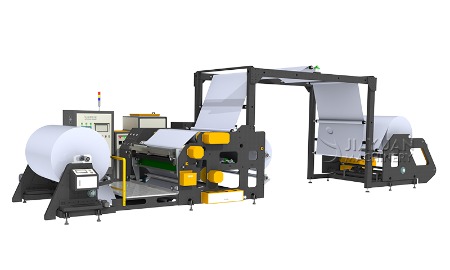
Adhesive coating machine
Cooling is equally critical in hot-melt coating. Immediately after the adhesive is applied, the web passes over a chill roll or through a cooling tunnel. The chill roll is a water-cooled drum that extracts heat quickly, solidifying the adhesive in milliseconds. The roll's surface temperature, pressure, and contact time determine the final crystallinity, which affects tack and cohesion. For thicker coatings, a series of cooling drums or air cooling may be used. In tape manufacturing, the coated side often contacts a release liner before winding; the liner also acts as a heat sink. Proper cooling prevents blocking—the adhesive sticking to the backing—which would ruin the roll. Temperature sensors monitor the web's exit temperature; if it exceeds a threshold, the line speed must be reduced or cooling increased. Some lines use infrared thermometers to measure the adhesive surface temperature without contact, enabling closed-loop control of the chill roll's coolant flow.
Maintenance of hot-melt adhesive coaters centers on preventing char and carbon buildup. Since the adhesive is held at high temperatures, thermal degradation produces insoluble particles that clog filters, valves, and die slots. Regular purging with cleaning compounds (e.g., low-viscosity polyethylene) is recommended. The melter should be drained and cleaned at scheduled intervals; the tank's internal surfaces must be scraped to remove gelled material. Heated hoses need inspection for insulation integrity and leaks; worn hoses can cause cold spots leading to viscosity spikes. Filters, typically screen packs with 40-100 mesh, must be changed when pressure drop increases by 30% above baseline. For dies, disassembly and ultrasonic cleaning in an appropriate solvent are done periodically. Operators should keep a log of melt temperature, pump pressure, and motor current to detect early signs of degradation. Spare parts—heating elements, thermocouples, seals, and filters—should be stocked to minimize downtime.
Application techniques vary widely: for contact coating, the die touches the substrate; for gap coating, a small air gap exists between die and web, allowing non-contact application. Gap coating reduces die wear and is preferred for thin films. The gap setting requires careful calibration using feeler gauges or laser displacement sensors. Some coaters have automatic gap adjustment based on thickness feedback. Additionally, the hot-melt adhesive can be applied in patterns—dots, lines, or grids—using rotary screen or slot die with patterned shims. This is common in diaper manufacturing where breathable bonding is needed. Process control systems must manage the interplay between line speed, melt flow, and cooling rate. A typical control algorithm uses cascade loops: master speed sets the pump speed, and the chill roll temperature adjusts based on exit temperature. Advanced systems use model predictive control to anticipate changes from speed variations. By mastering these thermal and mechanical aspects, hot-melt adhesive coaters deliver reliable, high-speed production with minimal environmental impact, making them indispensable in modern converting lines.