Hot Melt Adhesive Coater Selection Guide: Capacity, Viscosity, and Substrate Compatibility
Choosing the right hot melt adhesive coater involves evaluating multiple factors: production capacity (kg/h), adhesive viscosity, substrate type, and required coating weight. Capacity is determined by the melter's output rate, which must match the line speed and coat weight. For example, a line running at 200 m/min with a 20 gsm coat weight on a 1.5 m wide web consumes approximately 360 kg/h of adhesive. The melter must have a reserve capacity (typically 20% above nominal) to handle peak demands and startup. Melter sizes range from 10 kg/h for small labs to over 1000 kg/h for industrial lines. For large outputs, grid melters with multiple heating zones are used to melt blocks rapidly without overheating. Tank-style melters are suitable for lower outputs and offer simpler operation. The hose and die must also be sized to deliver the required flow without excessive pressure drop; larger diameter hoses reduce pressure loss but increase thermal inertia.
Adhesive viscosity is perhaps the most critical parameter. Hot melts are available in low-viscosity (500 cP), medium (5000 cP), and high-viscosity (100,000 cP) grades. Low-viscosity adhesives are used for porous substrates like paper, as they penetrate easily; they require fine filtration and tight die gaps. High-viscosity adhesives are used for nonwovens and tapes, needing robust gear pumps and heated dies with wider slots. The coater's pump type must match the viscosity: gear pumps handle up to 200,000 cP, while screw pumps are better for extremely high or shear-sensitive materials. Pump speed control must be precise; a variable-frequency drive with encoder feedback is standard. Also, the pump's internal clearances must be appropriate—tight clearances for low viscosity, larger for high viscosity to avoid cavitation. The melter's heating capacity must raise the adhesive to its application temperature quickly; a rule of thumb is 1 kW of heating power per 1 kg/h of melt output.
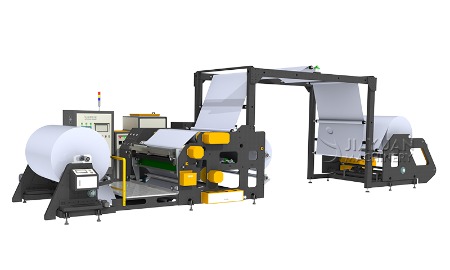
Adhesive coating machine
Substrate compatibility influences the coating method and cooling system. Thin films (e.g., polypropylene, PET) cannot withstand high nip pressure or excessive heat, so non-contact slot-die with air gap coating and gentle cooling are preferred. Thick substrates like cardboard or foam can handle roll coating and higher pressures. For temperature-sensitive substrates, the adhesive must be applied at the lowest possible temperature, requiring low-melt adhesives and efficient die design to minimize heat transfer to the substrate. Additionally, the substrate's surface energy may require corona treatment to improve wetting, even with hot melts. For release liners, the coater must have a laminating station to apply the liner after cooling; the liner's silicone coating must withstand the adhesive's temperature without delaminating. The machine's web handling system must accommodate the substrate's flexibility and thickness; for example, a 12-micron film needs dancer rolls with very low inertia to prevent breakage.
Coating weight range is another selection factor. For PSA tapes, coat weights are typically 15-30 gsm; for packaging, 5-15 gsm; for nonwovens, 1-5 gsm. The coater's die design and pump resolution must be capable of the target weight with acceptable tolerance. Slot-die coaters excel in low coat weights (down to 2 gsm) with high uniformity. Roll coaters are less accurate but can apply heavy coats (>50 gsm) easily. The control system should allow quick recipe changes to switch between products; automated die gap setting and pump calibration reduce changeover time. Also, the line speed range is important: some coaters are optimized for low speed (10-50 m/min) for specialty products, others for high speed (300-600 m/min) for commodity tapes. High-speed coaters need advanced cooling to avoid blocking, often using multiple chill rolls.
Additional considerations include safety features, ease of cleaning, and floor space. Hot-melt systems operate at high temperatures, so thermal guards and warning signs are mandatory. Melters should have overtemperature protection and relief valves. Cleaning access doors and removable panels simplify maintenance. Some coaters have built-in flush tanks to circulate cleaning fluid through the die and hoses, reducing manual disassembly. The coater's footprint varies widely; compact units for small shops, while large lines require significant real estate. It's wise to consult with the adhesive supplier, as they can recommend the optimal application temperature and viscosity range for their product. Running trials with sample adhesives on potential coaters is strongly advised—this reveals actual performance, defect propensity, and ease of operation. Finally, consider the supplier's reputation and after-sales support, including training, spare parts availability, and field service response time. A well-selected
hot melt adhesive coater will provide years of trouble-free service and consistent output, enhancing overall manufacturing profitability.