Hot Melt Coating vs Solvent Coating: Performance Trade-offs, Application Suitability, and Future Trends
The performance of a PSA tape is largely determined by the adhesive chemistry. Hot melt adhesives are based on styrenic block copolymers (SIS, SBS) blended with tackifiers and plasticizers. They are thermoplastic and do not crosslink (unless specially formulated). Their performance is characterized by high tack and good peel adhesion, but moderate shear and low heat resistance (softening point around 80-100°C). They also have poor resistance to plasticizers and oils. Hot melt PSAs are ideal for applications that require high initial tack and peel, such as packaging tapes, masking tapes, and low-cost labels. However, they are not suitable for high-temperature applications (e.g., automotive) or for long-term outdoor exposure, as they degrade under UV and heat. Solvent-based acrylic PSAs are crosslinked (through isocyanates or melamines) and have a thermoset structure. They offer excellent heat resistance (up to 150°C), high shear strength, good UV resistance, and resistance to oils and solvents. They have moderate tack and peel but can be tailored to a wide range of applications. Solvent-based acrylics are used for high-performance tapes: automotive exterior tapes, electronic tapes, double-sided mounting tapes, and medical tapes. They are also used for optical clear adhesives. The coat weight for solvent-based acrylics can be very low (5-15 gsm) with excellent uniformity, which is important for optical applications. In contrast, hot melt adhesives are typically applied at 15-30 gsm; below 15 gsm, the coating may be uneven due to the adhesive's high viscosity. The choice of technology is thus driven by the performance requirements: if the tape must withstand high temperatures, exposure to chemicals, or long-term durability, solvent-based is the choice. If the tape is for general-purpose, low-cost applications, hot melt is suitable. Some applications, such as medical tapes, may use both: silicone-based PSAs (which can be solvent or hot melt) for skin-friendly tapes, and acrylics for high-bond tapes.
The application suitability also depends on the substrate. Hot melt adhesives have good adhesion to many plastic films (PP, PET) and paper, but they may not adhere well to low-energy surfaces (PE, PTFE) without a primer. Solvent-based acrylics can be formulated to adhere to a wide range of surfaces, including low-energy ones, by using appropriate monomers. The coating process for hot melt is faster and easier, but it requires the adhesive to be stable at high temperatures; some hot melts degrade if held at melt temperature for too long. Solvent coating allows the use of a broader range of polymers and crosslinkers, offering greater formulation flexibility. The drying process for solvent coating can also serve as a crosslinking step, which is not possible with hot melt. However, solvent coating is slower due to the drying limit. The line speed for hot melt can be 2-3 times higher than solvent coating for the same coat weight, making it more productive. The choice is also influenced by the availability of raw materials and the supplier's expertise. In summary, the selection between hot melt and solvent coating is a strategic decision that balances performance, cost, speed, and sustainability. Many manufacturers offer both technologies to serve different market segments.
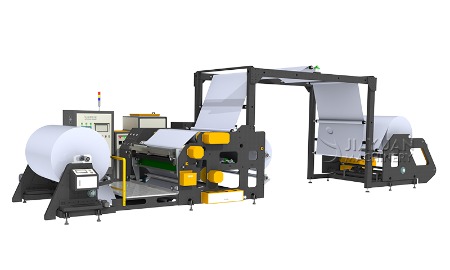
Adhesive coating machine
Future trends are reshaping the landscape. Bio-based hot melt adhesives derived from renewable resources (plant oils, starches) are being developed to reduce the carbon footprint and improve sustainability. These adhesives have comparable performance to petroleum-based hot melts but require careful processing to avoid degradation. Low-VOC solvent systems, such as high-solids (>70%) and solvent-free formulations, are being developed to reduce emissions while maintaining the high performance of solvent-based acrylics. These high-solids adhesives have lower viscosity and can be coated with modified equipment. The development of water-based acrylics is another trend; they have lower VOCs than solvent-based, but they require longer drying and may have lower heat resistance. The coating machine manufacturers are developing hybrid systems that can handle both hot melt and solvent coating with quick changeovers, allowing manufacturers to switch between technologies as needed. The regulatory pressure on VOCs is increasing globally, favoring hot melt and water-based technologies. However, the demand for high-performance tapes in emerging sectors (electric vehicles, flexible electronics) will continue to drive the development of advanced solvent-based and UV-curable systems. In summary, the hot melt vs solvent coating choice is evolving with sustainability and performance needs; the future will see a more diverse range of technologies, each optimized for specific applications, with a strong emphasis on reducing environmental impact while maintaining or improving product quality.