Hot Melt Coating vs Solvent Coating: Technology Comparison, Process Economics, and Environmental Impact
Hot melt coating and solvent coating are the two dominant technologies for applying pressure-sensitive adhesives (PSAs) onto substrates. Hot melt coating uses adhesives that are 100% solid at room temperature and are applied molten (at 120-180°C); they solidify upon cooling, with no solvent to evaporate. Solvent coating uses adhesives dissolved in organic solvents (e.g., toluene, ethyl acetate); the solvent is evaporated in a drying oven, leaving the solid adhesive film. Each technology has distinct advantages and limitations. Hot melt coating is solvent-free, which eliminates VOC emissions, eliminates the need for solvent recovery, and reduces energy consumption (no drying oven). The equipment is simpler and more compact (no long oven), and the line speed can be very high (up to 600 m/min). However, hot melt adhesives have limited heat resistance (typically up to 100-120°C) and lower shear strength compared to crosslinked solvent-based acrylics. They also have a narrower coating window and are less suitable for very thin, uniform coatings (<10 gsm). Solvent coating, on the other hand, can produce very thin, uniform, and high-performance coatings with excellent heat resistance and weatherability. The adhesive can be crosslinked during drying to achieve high shear and solvent resistance. However, solvent coating requires explosion-proof equipment, solvent recovery systems (carbon adsorption or thermal oxidizer), and long drying ovens (30-50 meters). The capital cost is higher, and the operating costs include solvent and energy costs, as well as environmental compliance costs. The choice between the two technologies depends on the application, performance requirements, production volume, and regulatory environment.
The process differences are significant. In hot melt coating, the adhesive is supplied as solid blocks or pellets, melted in a tank (melter), and pumped through heated hoses to the coating head (typically a slot-die or roll coater). The temperature must be precisely controlled to maintain consistent viscosity; a ±1°C variation can change viscosity by 5-10%. The coating is applied to the substrate, and then immediately cooled by a chill roll or cooling air to solidify. No drying oven is needed. In solvent coating, the adhesive is supplied as a liquid solution with a solids content of 30-50%. It is pumped to the coating head (slot-die, gravure, or roll) and applied to the substrate. The coated web then enters a multi-zone drying oven where heated air evaporates the solvent. The solvent-laden air is exhausted to a recovery system. The oven temperature profile is critical to avoid skinning and ensure complete solvent removal. The line speed is limited by the drying capacity; to increase speed, the oven must be longer or hotter. The solvent coating process also requires solvent handling and storage facilities, as well as safety interlocks for explosion protection. The coat weight control in hot melt coating is stable because the adhesive is 100% solids; the coat weight is directly proportional to the flow rate and speed. In solvent coating, the coat weight depends on the flow rate, speed, and solids content; any change in solids fraction (due to evaporation in the tank) affects the coat weight, requiring compensation. In summary, the process complexity is higher for solvent coating, but it offers greater flexibility in formulation and performance.
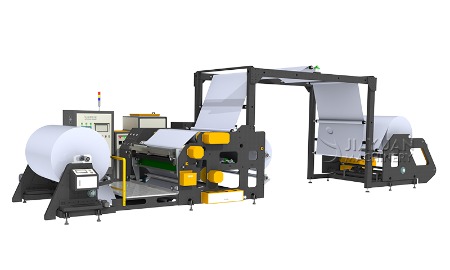
Adhesive coating machine
The environmental and safety aspects are critical. Solvent coating emits VOCs, which are regulated by environmental agencies; the emissions must be captured and treated. Solvent recovery systems can be expensive to install and operate, but they recover the solvent for reuse, offsetting some cost. The solvent also poses fire and explosion hazards; the coating line must be explosion-proof, and the operators must wear protective gear. The solvent can also affect the health of workers; proper ventilation and monitoring are required. Hot melt coating has none of these issues; it is safer and more environmentally friendly. The energy consumption of hot melt coating is significantly lower because there is no drying oven; only the melter and heated hoses consume energy. Solvent coating consumes large amounts of energy to heat the oven and evaporate the solvent; the energy cost can be a major operating expense. The total cost of ownership (TCO) for solvent coating is higher due to the higher capital cost, energy cost, and solvent cost (even with recovery, there are losses). Hot melt coating has a lower TCO for most commodity tapes and labels, but for high-performance tapes that require solvent-based acrylics, the higher cost is justified by the performance. The choice is often driven by the product's performance requirements and the company's sustainability goals. In summary, hot melt coating is the preferred technology for low-cost, high-speed, and environmentally friendly applications, while solvent coating is essential for high-performance, heat-resistant, and durable tapes.