Hygiene Adhesive Coating: Applications, Adhesive Types, and Coating Methods for Nonwovens
Hygiene adhesive coating is a specialized field that produces adhesives used in the assembly of disposable hygiene products. Unlike tapes or labels, hygiene adhesives are not exposed to the user; they are used to bond the various components of a diaper or pad: the nonwoven top sheet, the absorbent core, the backsheet, and the elastic strands. The adhesives must be applied in precise patterns and quantities to ensure the product's integrity, flexibility, and comfort. The most common adhesive is hot-melt, based on styrenic block copolymers (SIS, SBS) blended with tackifiers and oils. These adhesives are solvent-free and applied at 120-170°C. They cool and solidify rapidly, bonding the components. Water-based adhesives are also used for some applications, but they require drying. The coat weight for hygiene adhesives is typically 0.5-5 gsm, which is much lower than for tapes. The application is done at high speeds (200-600 m/min) on wide webs (up to 4 meters). The coating equipment must be capable of applying the adhesive in patterns: spiral spray, slot-die, or bead. The adhesive must remain soft and flexible after solidification to maintain the product's drape. It must also be non-toxic and non-irritating to the skin, as the product is in close contact with the user's skin. The adhesive must pass skin compatibility tests. The hygiene adhesive coating line is often integrated into the diaper machine, where the nonwoven and other materials are assembled.
The main applications of hygiene adhesives are: construction bonding (joining the top sheet and the backsheet around the core), elastic attachment (gluing elastic strands to the backsheet to create gathers), and core stabilization (spraying adhesive on the absorbent core to keep it in place). Each application has different requirements. Construction bonding requires a wide, low-coverage pattern that provides adequate strength without stiffening the product. Elastic attachment requires a narrow, high-strength bond to keep the elastic strands in place; the adhesive must have good heat resistance and high cohesion. Core stabilization uses a light spray to prevent the superabsorbent particles from shifting. The adhesive supplier provides specific formulations for each application. The coating method is selected based on the required pattern and coat weight. Spiral spray is the most common for construction bonding; it uses a nozzle that applies a spiral pattern, which gives a wide coverage with low grammage. The spiral pattern is created by swirling air; the adhesive is extruded as a thin thread that oscillates. The spray width and pattern can be adjusted by air pressure and nozzle design. Slot-die coating is used for elastic attachment and core stabilization; it provides a precise, narrow strip of adhesive. The slot-die gap and flow rate set the coat weight. Bead application uses a simple nozzle to apply a continuous or intermittent bead of adhesive; it is used for core stabilization and for some construction applications. The coat weight is controlled by the pump speed and the line speed. The adhesive temperature must be controlled to ±2°C to ensure consistent viscosity. The adhesive application system includes a melter, heated hoses, and the nozzles or dies. The system must be cleaned regularly to prevent charring and nozzle clogging.
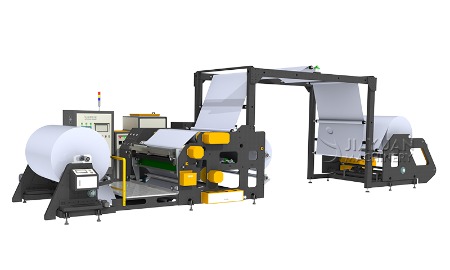
Adhesive coating machine
Quality requirements for
hygiene adhesive coatings include uniform coat weight, precise pattern placement, and minimal stringing (the formation of thin adhesive threads that can be felt by the user). Stringing is a common defect caused by too high application temperature or too low viscosity; it is corrected by adjusting the temperature or the nozzle design. The adhesive must not be applied too close to the edges to avoid blocking during winding. The coat weight is measured by weighing samples or by using an online beta gauge; for spray patterns, the coverage is checked by a color indicator. The adhesive bond strength is tested by peel and shear tests. The product's comfort is assessed by sensory tests; the adhesive must not stiffen the product. The hygiene adhesive coating line must be synchronized with the converting machine; the adhesive application must be triggered by the product's position (e.g., by a photoelectric sensor that detects the core). The control system uses a servo-driven pump that can start and stop rapidly for intermittent application. The nozzles must have a quick response to avoid over-spray. The machine's maintenance includes cleaning the nozzles, checking the air supply, and verifying the temperature controllers. The adhesive melter must be kept clean to avoid degradation. In summary, hygiene adhesive coating is a fast, precise, and demanding process that requires careful control of temperature, pattern, and coat weight. It is essential for producing comfortable, reliable, and cost-effective disposable hygiene products.