Hygiene Adhesive Coating: Process Optimization, Defect Prevention, and Sustainability Trends
Optimization of hygiene adhesive coating begins with the hot-melt adhesive's rheology. The adhesive's viscosity is temperature-dependent; the application temperature is set to achieve a viscosity of 1000-5000 cP for spray applications and 5000-20,000 cP for slot-die applications. Too high a temperature reduces viscosity, causing stringing and overspray; too low a temperature increases viscosity, causing poor pattern formation and insufficient wetting. The optimal temperature is determined by the supplier and verified by a viscometer. The pump speed must be synchronized with the line speed; for intermittent applications, the pump must have a fast acceleration and deceleration to avoid adhesive tails. The nozzle air pressure for spiral spray controls the pattern width and the thread diameter; higher pressure gives a wider pattern and finer threads but may cause overspray. The air pressure is typically 0.5-2 bar. The slot-die gap for elastic attachment is set to 0.1-0.3 mm; the gap uniformity is critical. The adhesive flow is regulated by a gear pump with a servo motor. The distance between the nozzle and the substrate affects the pattern width; for spiral spray, the distance is 10-30 mm. The pattern is inspected visually or by a camera system; any deviation is corrected. The bond strength is tested by peeling the bonded components; if the strength is too low, the coat weight or temperature may need to be increased. The optimization is done through a DOE varying temperature, pressure, and coat weight, and measuring the bond strength and stringing. The resulting response surfaces guide the selection of the operating point. The optimized settings are stored in the product recipe. The machine's control system ensures that the settings are maintained during production; alarms are triggered if the parameters drift.
Defect prevention in hygiene adhesive coating focuses on stringing, adhesive bleed-through, and nozzle clogging. Stringing is reduced by optimizing the temperature and air pressure; a slightly lower temperature and higher air pressure can break the threads. The use of a non-stick coating on the nozzle (e.g., Teflon) also helps. Adhesive bleed-through occurs when the adhesive penetrates the nonwoven or the backsheet, causing stiffness or skin irritation. It is prevented by using a higher-viscosity adhesive, reducing the coat weight, or applying the adhesive in a pattern that minimizes contact. Nozzle clogging is caused by charred adhesive or dirt; it is prevented by regular cleaning and by using a filter in the supply line. The filters should be changed according to the schedule. The adhesive melter must be cleaned periodically to remove degraded polymer; the cleaning cycle is set by the maintenance plan. The adhesive hoses must be inspected for leaks and thermal insulation. The application system should have a "purge" function to clear the nozzles before shutdown. The quality control includes online inspection of the adhesive pattern using a camera; if a defect is detected, the line may be stopped or the section marked for rejection. The defect data is logged for SPC. The operators are trained to recognize stringing and clogging early and to adjust the parameters. In summary, defect prevention is a combination of proper parameter setting, regular maintenance, and vigilant operator monitoring.
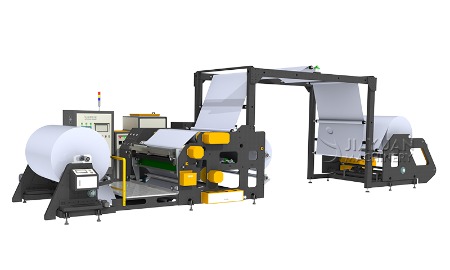
Adhesive coating machine
Sustainability is a growing trend in
hygiene adhesive coating. Manufacturers are moving towards bio-based adhesives derived from renewable resources (e.g., plant-based oils, starches) to reduce the carbon footprint. These adhesives require careful processing because their thermal stability may be lower. The coating line must be able to operate at lower temperatures (e.g., 100-140°C) to prevent degradation. This reduces energy consumption and also reduces the risk of thermal damage to the nonwoven substrates. Another trend is the reduction of adhesive coat weight; by using more efficient application patterns (e.g., micro-fiber spray), the same bond strength can be achieved with 20-30% less adhesive. This saves material and reduces the product's weight. The use of renewable energy sources for the heating of the melter and the line is also becoming common. The sustainability trend also includes the design of the adhesive for easier recycling of the hygiene products. The coating machine must be adaptable to new, sustainable materials; this requires flexibility in the application system (e.g., interchangeable nozzles) and the control system (adjustable temperature profiles). The coating line suppliers are developing systems that can handle both traditional and bio-based adhesives with minimal changeover. In conclusion, hygiene adhesive coating is evolving towards greater efficiency, lower environmental impact, and higher product quality. By optimizing the process, preventing defects, and adopting sustainable practices, manufacturers can meet the demands of the market while contributing to a greener future.