Inline Coating: Integration, Synchronization, and Process Control for Continuous Production Lines
Inline coating is the practice of placing a coating head—such as a slot-die, gravure, or roll coater—directly within a larger converting or manufacturing process, rather than as a separate, off-line operation. Typical inline applications include: priming of films before printing, adhesive application before lamination, protective coating on extruded profiles, and surface treatment of papers. The primary advantage is the elimination of intermediate handling: the substrate is coated and then immediately processed in the next step, reducing labor, floor space, and work-in-progress inventory. Inline coating also allows real-time process control: the coating thickness can be adjusted based on the upstream substrate properties or the downstream quality feedback. However, inline coating imposes strict requirements on synchronization: the coater must match the speed and tension of the main line, and any stoppage in the line affects the coating section. The coating head must be compact, easily accessible for cleaning, and capable of rapid changes. The inline coater is often placed after the substrate formation or pretreatment (e.g., corona) and before the drying/curing section, which may be shared with the downstream process. The design must consider the web path, the space constraints, and the need for quick changeover. In summary, inline coating is a sophisticated integration that offers significant operational benefits when properly engineered.
Synchronization is the most critical aspect of inline coating. The coating head's speed must be precisely matched to the main line's speed to maintain a constant coat weight. The control system uses a master speed signal from the line's main drive; the coating head's pump speed is set as a ratio of this master speed (feedforward control). The ratio is adjusted by the feedback from a thickness gauge placed after the coating head. The tension in the coating zone must be compatible with the rest of the line; often, a dancer roll or a tension isolation zone is used to decouple the tensions. The coating head must have a fast response to speed changes: if the line speed changes due to a splice or a product change, the pump speed must change proportionally and quickly to avoid coat weight errors. The coating head's mechanical inertia must be low; lightweight rolls and direct drives are preferred. The inline coater also requires a quick-change mechanism for the die or the gravure cylinder to reduce downtime when changing products. The synchronization is typically managed by a PLC with a high-speed communication bus (EtherCAT, SERCOS) that ensures all drives are updated within milliseconds. In summary, synchronization is the key to maintaining quality in
inline coating.
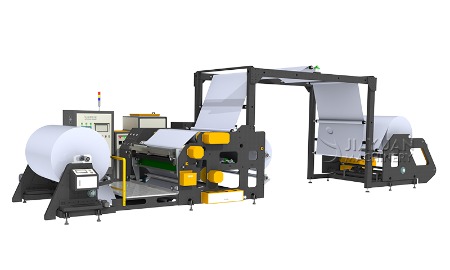
Adhesive coating machine
Process control for inline coating must handle the interactions between the coating and the upstream/downstream processes. For example, if the substrate's surface energy varies (e.g., due to changes in the corona treater), the coating wetting may change, affecting the coat weight. The control system should include a feedforward loop from the corona treater's power to the coating head's pump speed to compensate. Similarly, changes in the line speed due to a downstream laminator's acceleration must be fed forward. The control system should also have a "hold" function: if the line stops, the coating head must stop immediately to prevent pooling; when the line restarts, the coating head must start with a synchronized ramp. The operator interface should display the line speed, the coating head speed, the coat weight, and the status of the synchronization. Alarms should be triggered if the speed ratio deviates beyond a safe limit. The control system should also log data for quality traceability. In summary, advanced process control with feedforward and feedback loops ensures that the inline coater operates seamlessly with the rest of the line.
Benefits and challenges: Benefits include reduced handling, lower labor costs, less waste (no storage of intermediate rolls), and the ability to adjust coating in response to real-time quality data. Challenges include: (1) The coating section becomes a single point of failure; any issue stops the entire line. (2) Changeovers are more complex because the upstream and downstream processes must be coordinated. (3) The coating head must be accessible for cleaning without disassembling the entire line. (4) The drying/curing section must be shared, which may limit the line speed if the coating requires a longer drying time. (5) The space is often tight, limiting the size of the coating head. To mitigate these challenges, the buyer should design the line with adequate space for maintenance, use quick-change dies, and have a well-defined changeover procedure. The buyer should also consider a "bypass" mode where the line can run without coating if the coating head needs maintenance. In summary, the benefits of inline coating usually outweigh the challenges when the process is high-volume and the product is stable, but careful planning is essential.
Applications and examples: (1) Film printing: a primer is coated inline before the printing unit to improve ink adhesion. (2) Lamination: an adhesive is coated onto one film and then immediately laminated to another film, all in one pass. (3) Paper coating: a barrier coating is applied inline on a paper machine before the calendering section. (4) Extrusion coating: a functional coating is applied to an extruded profile inline. In each case, the inline coater is custom-engineered to fit the available space and to match the line's speed. The buyer should work with the coating machine manufacturer and the line integrator to design the inline system. In conclusion, inline coating is a powerful technique for improving production efficiency and reducing costs. By integrating the coating step with the rest of the process, manufacturers can achieve a lean, continuous production flow, with real-time quality adjustment, and a faster time-to-market. The key to success is a thorough understanding of the process interactions, robust synchronization, and a well-maintained, accessible coating system.