Inline Coating: Retrofit, Compatibility, and Troubleshooting for Existing Production Lines
Retrofitting an inline coating station is a common practice to enhance the capabilities of an existing production line without investing in a completely new line. The first step is a feasibility study: assess the available space, the line's speed range, the existing tension control system, the available utilities (power, air, exhaust), and the potential for installing a drying/curing section. The coating head must fit into the line without interfering with existing equipment. The web path must be modified to include the coating head; this may require adding new idler rolls and a new tension zone. The line's control system must be expanded to control the coater; this may require a new PLC or an upgrade of the existing one. The compatibility of the coating fluid with the existing downstream equipment (e.g., drying ovens) must be checked; if the coating requires a higher temperature, the oven may need modification. The buyer should also consider the impact on the line's overall uptime; adding a new component introduces a new potential failure point. A detailed risk assessment should be performed. In summary, retrofitting is feasible for most lines, but it requires careful engineering and a realistic budget.
Compatibility issues are common in retrofits. The existing line's tension control may not be designed for the additional drag of the coating head; a new tension isolation zone (dancer roll or idler with load cell) may be needed. The existing speed control may have limited bandwidth; upgrading the drives and the communication network may be necessary. The existing oven may not have the capacity to dry the new coating; adding a new, dedicated oven section may be required. The existing edge guide may not be able to handle the web's new position; adjustment or replacement may be needed. The coating fluid may be incompatible with the existing roll coverings; for example, solvent-based fluids may attack rubber rolls, requiring chrome-plated rolls. The buyer should work with a system integrator to identify all compatibility issues and to develop solutions. In summary, compatibility is a key challenge in retrofitting; a thorough audit is essential.
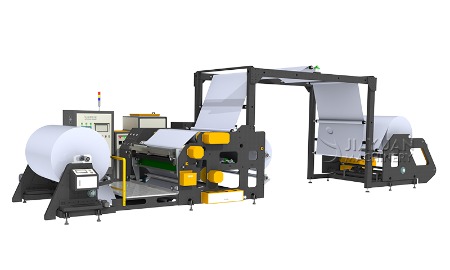
Adhesive coating machine
Troubleshooting
inline coating retrofits often involves issues such as speed mismatch, where the coating head's speed lags behind the line speed during acceleration. This is solved by fine-tuning the feedforward gain and by using a high-response servo motor. Tension disturbances can cause wrinkles or breaks; adding a dancer roll or a load cell to the new tension zone can isolate the coating head from upstream disturbances. Contamination is another issue: the coating head can drip or splash, contaminating the downstream equipment; installing drip trays and splash guards, and using a vacuum assist for the bead, can mitigate this. Coating defects such as streaks may appear due to misalignment of the die to the existing rolls; a careful alignment using laser tools is required. The drying/curing may be insufficient if the existing oven is not designed for the coating's solvent load; adding an IR pre-heater or increasing the oven's airflow may help. The operator should keep a log of all issues and the corrective actions taken. In summary, troubleshooting a retrofit requires a systematic approach, using the line's data and the operator's observations.
Best practices for a successful retrofit: (1) Involve all stakeholders—production, maintenance, quality, and engineering—from the start. (2) Conduct a detailed site survey to measure the available space and the existing equipment's condition. (3) Use a modular coating head design that can be easily removed for maintenance. (4) Upgrade the control system to a modern platform with high-speed communication. (5) Plan the installation during a scheduled shutdown to minimize production loss. (6) Conduct extensive testing during commissioning, starting at low speed and gradually increasing. (7) Train the operators on the new system and the integration. (8) Document the new procedures and update the line's technical manuals. In conclusion, retrofitting an inline coating station is a practical way to add value to an existing production line. With proper planning, engineering, and troubleshooting, the new coating capability can improve product quality, reduce costs, and open new market opportunities. The key is to treat the retrofit as a full-scale project, with clear milestones, a dedicated project manager, and a focus on safety and quality.