Innovations in Adhesive Coating Machines: Sustainable and High-Speed Solutions
The adhesive coating industry is undergoing rapid transformation driven by environmental regulations, demand for higher productivity, and the rise of electric vehicles and flexible electronics. Modern coating machines are evolving to address these trends with innovative designs. One major innovation is the adoption of solvent-free coating technologies, such as hot-melt and UV-curable systems, which eliminate VOC emissions and reduce energy consumption for drying. Hot-melt coaters now feature advanced melting grids that deliver consistent temperature and flow, even at high output rates. UV coaters incorporate LED lamps that offer longer life, lower heat emission, and instant on/off capability, reducing power usage by up to 50% compared to conventional mercury lamps. Water-based adhesives are also gaining traction, requiring coaters with efficient dewatering and high-capacity air circulation ovens. Some new coaters combine multiple drying methods (IR + convection) in a single compact zone to accelerate water evaporation while maintaining film integrity.
Another significant trend is the integration of intelligent sensors and closed-loop control systems. Modern adhesive coating machines are equipped with coat-weight sensors (beta, X-ray, or optical) that provide real-time feedback to adjust pump speed, die gap, or slot pressure dynamically. This maintains uniformity within ±0.5%, far exceeding traditional manual adjustments. Some systems use machine vision to detect micro-defects like gels, fish eyes, or contamination, with automated rejection marking. Predictive maintenance algorithms analyze vibration and thermal data to forecast component wear, scheduling alerts days in advance. This reduces unplanned downtime and extends service intervals. The convergence of operational technology (OT) and information technology (IT) allows remote monitoring and optimization from cloud platforms, enabling multi-site production harmonization. For large manufacturers, this digital twin concept replicates the coating line virtually, allowing what-if analysis and process optimization without interrupting production.
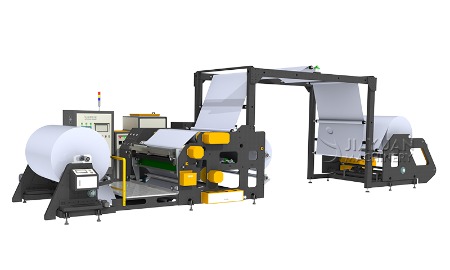
Adhesive coating machine
High-speed operation is a relentless demand, with new machines reaching 800-1200 m/min for PSA tapes. Achieving such speeds requires innovations in air handling—drying ovens with impingement nozzles that deliver high-velocity air to break boundary layers, enhancing solvent evaporation. Also, the coating head must minimize pressure drop and prevent flow-induced defects. Slot-die designs with optimized internal manifold (channels that distribute flow uniformly across the width) are being improved using computational fluid dynamics (CFD) simulations. This ensures that the velocity profile is flat even at very high flow rates. Additionally, the web handling system must cope with high inertia; carbon fiber rolls are increasingly used to reduce weight and improve acceleration. Tension control with fast-response actuators and predictive feed-forward algorithms ensures stability during speed changes. All these improvements enable adhesive coaters to run faster without compromising quality.
Sustainability extends beyond solvent reduction to include material efficiency and recyclability. Coating machines now feature edge trimming recirculation systems that collect edge bead and return it to the supply tank, reducing waste by up to 10%. Optimized slot-die shims reduce starting and stopping scrap. Heat recovery from oven exhaust is used to preheat incoming air or the adhesive itself, cutting energy costs. Some manufacturers use bio-based adhesives that require lower processing temperatures, further saving energy. The machine frames are designed with modularity to allow easy upgrades, extending the life of the equipment and reducing the carbon footprint of replacement. Additionally, washable and reusable filters replace disposable ones in many modern systems. These sustainability measures not only comply with regulations but also appeal to environmentally conscious customers.
Looking forward, adhesive coating machines are moving towards fully autonomous operation. AI-powered recipe optimization can suggest the best parameter set based on target coat weight and substrate properties, learning from historical data. Collaborative robots (cobots) are beginning to assist in die cleaning and roll changes, reducing human exposure to hazardous materials. 3D printing of custom die inserts allows rapid prototyping for new adhesive patterns. The future machine will be a self-optimizing entity that communicates with upstream and downstream equipment to synchronize the entire converting process. While these innovations promise remarkable gains, they also require a workforce skilled in data analytics and mechatronics. Therefore, manufacturers are partnering with educational institutions to develop training curricula. In conclusion, the adhesive coating machine of tomorrow will be faster, greener, smarter, and more adaptable, enabling the production of next-generation adhesive products that meet evolving market needs.