Intermittent Coating: Advanced Valves, Pattern Generation, and Synchronization for High-Speed Lines
High-speed valves are the critical component in intermittent coating. The valve must be capable of millions of cycles without failure, with a response time of less than 5-10 ms. Pneumatic valves are common for moderate speeds; they are cost-effective but have a limited duty cycle and a slower response. Servo-driven valves, using a high-speed motor and a ball-screw mechanism, offer response times of 2-3 ms and are used for very high-speed lines. The valve's internal design should minimize dead volume to reduce the pressure transient. The valve should be heated (for hot-melt) or cooled to maintain the fluid's temperature. The valve seat and the seals must be compatible with the fluid. The valve's wear life is a major consideration; using a valve with a replaceable seat and seals reduces the replacement cost. The buyer should select the valve based on the required frequency, the line speed, and the fluid's properties. In summary, the valve is the heart of the intermittent coating system; its performance directly determines the edge quality and the consistency of the coating pattern.
Pattern generation software allows the operator to define complex coating patterns: not just simple rectangles but also stripes, dots, zigzags, and other shapes. The software takes the pattern design and converts it into a sequence of valve on/off commands, synchronized with the web's position (from the encoder). For multi-head systems, the software coordinates the heads to create combined patterns. The software can also adjust the pattern in real-time based on feedback from an inspection camera: if the pattern drifts, the software shifts the valve timing to correct it. The software should have a user-friendly interface that allows the operator to import CAD files or to draw patterns directly. The pattern data is stored in the recipe for each product. In summary, pattern generation software simplifies the creation and management of complex intermittent coating patterns.
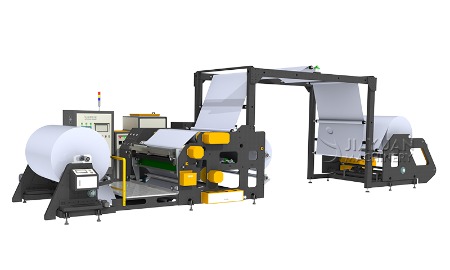
Adhesive coating machine
Synchronization with the web speed is critical. The valve timing must be based on the web's absolute position, not just the speed. This is achieved using a high-resolution encoder on the main pull roll, which provides pulses at a known distance (e.g., 0.1 mm per pulse). The control system counts these pulses to determine the web's position. The valve is opened when the count reaches the "start" value and closed at the "end" value. This position-based control ensures that the pattern repeats exactly, even if the speed fluctuates. For high-speed lines, the encoder frequency can be very high; the PLC must have a high-speed counter input capable of handling 100 kHz or more. The control system must also compensate for the valve's response time: the opening command is sent slightly in advance to account for the valve lag. This is done by a "lead" parameter in the recipe. In summary, precise position-based synchronization is the foundation of accurate
intermittent coating.
Pressure control optimization is essential for reducing the taper. The taper is caused by the pressure transient when the valve opens or closes. To minimize it, the fluid delivery system should include a bypass loop that maintains a constant pressure at the valve inlet, regardless of the valve's state. The bypass flow is recirculated to the tank. When the valve opens, the flow is diverted from the bypass to the die; the pressure drop should be minimal. The bypass loop should have a pressure regulator and a flow meter. The die itself should have a small internal volume to reduce the transient. The control system can also use a "soft start" function: the valve opens slowly over a few milliseconds to allow the pressure to build gradually, reducing the taper at the leading edge. Similarly, a "soft stop" function can reduce the trailing taper. The optimal settings are determined by trial and error, using a high-speed camera and a profilometer to measure the taper. In summary, optimized pressure control is the key to achieving sharp, consistent edges in intermittent coating.
Practical implementation tips: (1) Use a high-speed camera to visualize the bead dynamics and the edge formation. (2) Measure the taper length and adjust the valve response and the pressure profile. (3) Use a data acquisition system to record the valve command and the actual pressure, and use this data to fine-tune the timing. (4) Regularly check the valve's wear and replace the seals and the seat as needed. (5) Keep a spare valve module for quick exchange. (6) Train operators on the pattern software and the troubleshooting of edge defects. In conclusion, advanced intermittent coating with high-speed valves, sophisticated pattern generation, and precise synchronization enables the production of complex, high-quality coated products at high speeds, meeting the demands of the battery, medical, and electronics industries. With continued advancements in valve technology and control algorithms, intermittent coating will become even more precise and versatile, opening new applications.