Intermittent Coating: Principles, Applications, and Control of Stop-Start Coating Processes
Intermittent coating, also known as stop-start or discontinuous coating, is a technique used when the coating is needed only in specific areas of the substrate, leaving gaps uncoated. The uncoated gaps allow for subsequent processes such as cutting, folding, or welding. For example, in battery electrode production, the coating is applied to the foil in a continuous pattern, but the foil is later slit and cut into individual electrodes; the uncoated tabs are used for electrical connections. In medical patches, the adhesive is applied in a specific pattern to avoid covering the active area. The coating head is activated and deactivated cyclically, creating a series of coated and uncoated regions. The key quality parameters are: (1) Coating length: the length of each coated segment; (2) Gap length: the length of the uncoated gap; (3) Edge sharpness: the transition between coated and uncoated areas should be abrupt, with minimal tapering or overspray. The control system must precisely synchronize the coating head's activation with the web speed to achieve the desired dimensions. In summary, intermittent coating enables the production of functional, multi-component products with precise placement of the coating.
The equipment for intermittent coating typically includes a coating head (slot-die, gravure, or spray), a high-speed shut-off valve, and a control system with precise timing. In slot-die coating, the fluid is supplied to the die through a valve that opens and closes rapidly. The valve is actuated by a servo or a pneumatic cylinder; the response time must be less than 10-20 ms to achieve sharp edges. The die gap and the pump pressure must be stable; any fluctuation during the start/stop cycle causes a variation in the coat weight at the leading or trailing edge. To minimize these transients, a bypass loop with a recirculation valve is often used: the fluid is continuously circulated, and the flow is diverted to the die when the valve opens. This maintains a constant pressure in the die, reducing the transient. A pulse dampener is installed to smooth out pressure ripples. The control system uses a PLC with a high-speed counter that triggers the valve based on the encoder pulses from the line's main drive. The coating length and gap length are set in the recipe, and the control system calculates the on/off timing. In summary, precise, fast-acting valves and a stable fluid supply are the keys to successful
intermittent coating.
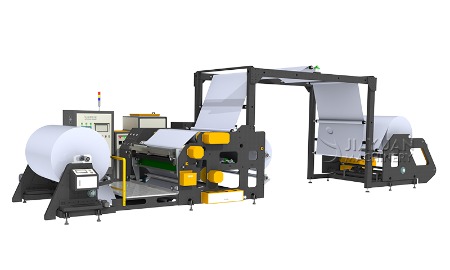
Adhesive coating machine
The control strategy for intermittent coating must handle the pressure transients that occur when the valve opens and closes. When the valve opens, the pressure in the die drops momentarily, causing a thinner coating at the leading edge; when the valve closes, the pressure builds up, causing a thicker coating at the trailing edge. To compensate, the control system may use a "ramp" function that gradually increases the pump speed during the first few milliseconds of the on-time and decreases it during the last few milliseconds, or it may use a "pre-flow" and "post-flow" adjustment. Advanced systems use a model-based control that predicts the pressure transient and adjusts the valve timing and the pump speed proactively. The edge sharpness is often characterized by the "taper" length—the distance over which the coat weight transitions from zero to the target value. A taper of less than 1 mm is considered excellent. The taper is affected by the valve response time, the fluid viscosity, and the line speed; higher speed requires faster valves. In summary, effective control of pressure transients is essential for achieving sharp edges and consistent coat weight in intermittent coating.
Applications of intermittent coating: (1) Battery electrode coating: the active material is coated onto the current collector foil in a pattern that leaves uncoated tabs for connection. (2) Medical patches: the adhesive is applied only to the perimeter of the patch, leaving the center free for the drug reservoir. (3) Label coating: the adhesive is applied in dots or stripes to allow easy peeling. (4) Electronics: conductive adhesive is applied in specific patterns for circuit connections. In each case, the intermittent coating process is optimized for the specific pattern and the fluid properties. The buyer should work with the coating machine supplier to design the valve and the control system for their specific application. In summary, intermittent coating is a versatile technique that enables the production of complex, value-added products.
Troubleshooting intermittent coating: (1) Taper too long: reduce the valve response time, increase the line speed, or adjust the pressure transient compensation. (2) Coating length variation: check the encoder pulses and the valve timing. (3) Gap length variation: similar to coating length. (4) Edge bead at the transitions: adjust the valve opening/closing profile. (5) Coating weight variation within the segment: check the pump stability and the pulse dampener. A systematic approach using a high-speed camera and pressure sensors is effective. In conclusion, intermittent coating is a demanding process that requires precise hardware and control. However, when properly engineered, it provides the ability to produce tailored, functional coatings with minimal waste, opening up new product possibilities for the coating industry.