Kiss Coater: Minimal Contact Coating for Thin and Gentle Applications
The kiss coater operates on a simple principle: a coating roll rotates partially submerged in a coating pan, picking up fluid on its surface. A doctor blade or metering roll controls the fluid thickness on the roll. The substrate passes over a backup roll, and the coating roll is positioned so that it just touches the substrate—hence the "kiss" contact. There is no nip pressure; the contact is gentle, and the transfer occurs due to the fluid's surface tension and the substrate's wettability. Because there is minimal compression, kiss coating is suitable for thin, fragile, or extensible webs like nonwovens, tissue paper, and thin films. It also allows coating both sides of the substrate simultaneously (with two kiss rolls). The coat weight is typically low—1 to 15 gsm—and the uniformity is moderate (±5-10%). Kiss coaters are cost-effective, easy to clean, and have low maintenance compared to reverse roll or slot dies. They are used for applying sizing, primers, release agents, and light adhesives in textile, paper, and packaging industries.
The coating weight in a kiss coater is governed by the fluid film thickness on the applicator roll and the contact time. The film thickness on the roll is set by the doctor blade or metering gap. The contact time is the duration the substrate is in contact with the roll, which is determined by the line speed and the contact arc length. A faster speed reduces contact time, thereby reducing pick-up. The contact arc can be adjusted by changing the roll's position relative to the backup roll; a larger arc increases pick-up. The fluid's viscosity and surface tension also affect pick-up; higher viscosity gives a thicker film, but if too high, the fluid may not transfer evenly. The kiss coater's roll is often an engraved or grooved roll to enhance fluid carry; a smooth roll is used for very thin coatings. The backup roll is usually hard, like steel, to provide a stable backing. The kiss roll itself can be rubber-covered for better fluid retention, but a hard chrome roll is common for precise metering. The pan is simple, with a level controller to maintain a constant fluid level. To prevent skinning on the roll, a slow rotation is maintained even when the line is stopped.
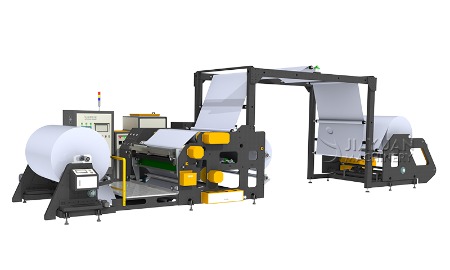
Adhesive coating machine
One of the primary advantages of kiss coating is the absence of nip pressure, which eliminates substrate deformation, stretching, or crushing. This is critical for nonwoven fabrics used in hygiene products, where any compaction reduces absorbency. Also, because there is no pressure, the risk of edge bead is minimal. The coating is applied only where the substrate contacts the roll; if the substrate is porous, the fluid may penetrate, reducing the surface coating. This can be beneficial for primers, but for barrier coatings, a less porous substrate or a thicker film is needed. Kiss coating is also very forgiving of web tension fluctuations; the contact is gentle enough that tension changes do not significantly affect coat weight. However, the uniformity is not as good as slot die or reverse roll; variations in substrate thickness or surface roughness can cause local variations. For products where uniformity is not critical (e.g., release coatings), kiss coating is perfectly acceptable.
Process optimization involves adjusting the roll speed, immersion depth, and doctor blade pressure. The roll speed is typically set to match the web speed or slightly higher (to increase pick-up). If the roll speed is too high, splashing occurs; if too low, the roll may not carry enough fluid. The doctor blade pressure affects the film thickness on the roll; a lighter blade gives a thicker film. However, if the blade is too light, it may not wipe evenly, causing streaks. The immersion depth—how deep the roll sits in the pan—affects the fluid pickup; deeper immersion gives more carry, but also more splashing. Usually, the roll is immersed to 20-50% of its diameter. The fluid temperature must be controlled to maintain constant viscosity; a heating jacket on the pan is common. For water-based fluids, a lid on the pan reduces evaporation. For solvent-based, the pan must be enclosed with exhaust to control vapors. Regular cleaning of the roll and blade is necessary; dried residue causes streaks. The pan should be drained and cleaned daily.
Defects in kiss coating include "starved areas" (where the substrate is not fully wetted), "streaks" from blade damage, and "splashing" from excessive speed. Starved areas occur when the fluid film on the roll is discontinuous; increasing the roll speed or reducing the blade pressure helps. Streaks require blade replacement or roll polishing. Splashing is controlled by reducing speed or using a guard. Also, "pick-off" can happen if the fluid is too tacky and adheres to the substrate while the roll continues to rotate, causing a chatter mark; adding a release agent or reducing viscosity solves it. For high-speed applications, some
kiss coaters use a "reverse kiss" where the roll rotates opposite to the web to reduce splashing and improve uniformity. Maintenance is straightforward: clean the roll and pan, inspect the doctor blade, check bearings, and verify roll parallelism. The kiss coater's simplicity makes it a popular choice for low-cost coating of wide webs (up to 5 meters) where high precision is not required. In summary, the kiss coater offers a gentle, efficient way to apply thin coatings on sensitive substrates, with low capital and operating costs. Its limitations in uniformity are offset by its versatility and ease of use.