Kiss Coater: Process Control, Fluid Pickup Models, and Maintenance Practices
The kiss coater's simplicity does not mean it lacks technical depth; process control is still essential. The primary controlled variables are the applicator roll speed, the doctor blade gap, and the fluid level in the pan. The roll speed is usually a fraction of the web speed—typically 20-80%. At lower speeds, the fluid film is more uniform; at higher speeds, centrifugal forces may throw off fluid, causing misting. The doctor blade gap sets the wet film thickness on the roll; this gap can be adjusted with micrometer screws, and it is often set to 0.05-0.3 mm. The gap must be uniform; a feeler gauge is used to check at multiple points. The fluid level in the pan is maintained by a float valve or a level sensor; a level change of ±5 mm can change the pickup by 1-2%. For precise work, a peristaltic pump with a closed-loop level control is used. Additionally, the fluid temperature must be stable; viscosity changes of 5% can alter coat weight by 3%. Thus, a temperature-controlled tank with circulation is recommended. Some coaters have a "pickup roll" that is separately driven to set the film thickness independent of the main drive, giving more flexibility.
Empirical models for coat weight in kiss coating are based on the equation: W = k * (roll film thickness) * (contact ratio), where k is a transfer coefficient (0.3-0.8) depending on the fluid and substrate. The roll film thickness is determined by the blade gap and the fluid's viscosity; it can be estimated by measuring the roll's wet film with a micrometer or by weighing the roll before and after wiping. The contact ratio is the fraction of the roll surface that actually contacts the substrate; it is affected by the substrate's roughness and the roll's compliance. For smooth substrates, the contact ratio is near 1.0; for rough nonwovens, it may be 0.7. To develop a robust control, operators should conduct a design of experiments varying roll speed, gap, and fluid temperature, and measure the resulting dry coat weight. A regression model is then fitted, which is used by the control system to set parameters for a target weight. This model needs recalibration when the fluid formulation changes or when the roll is reground.
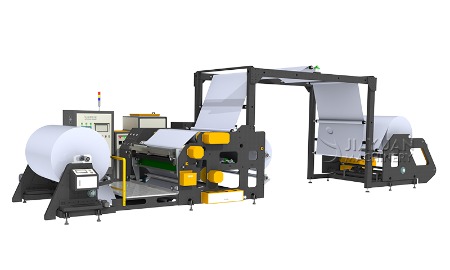
Adhesive coating machine
The doctor blade is a key maintenance item. It is a thin steel blade (0.2-0.5 mm thick) that presses against the applicator roll to scrape excess fluid. The blade pressure and angle are critical: too much pressure increases wear on the roll and blade; too little allows fluid to pass, causing thick coating. The blade should be adjusted to produce a clean, uniform wipe. Blade wear causes a dull edge, leading to streaks; a worn blade should be replaced or re-sharpened. The blade's contact angle is typically 30-60 degrees. For abrasive fluids, a ceramic-tipped blade extends life. The blade holder must be parallel to the roll axis; any skew causes non-uniform doctoring. Some
kiss coaters have an oscillating doctor blade that moves laterally to distribute wear and prevent grooving. The blade should be cleaned with solvent at the end of each shift to prevent dried buildup. The applicator roll itself requires regular inspection; any scratches or pits must be polished out. If the roll is rubber-covered, the cover should be checked for swelling or cracking; replace if necessary. The roll bearings should be greased per schedule; excessive play causes uneven contact.
Fluid management is another aspect. The coating pan must be cleaned thoroughly to prevent cross-contamination between different coatings. For water-based fluids, biocide addition prevents bacterial growth; for solvent-based, the pan must be covered to reduce evaporation. The fluid should be filtered continuously; a 100-mesh filter in the recirculation line removes particles. The pan level should be maintained; if it drops, the roll may not pick up enough fluid. Also, the fluid should be mixed gently to keep solids suspended; a magnetic stirrer or a small pump recirculation is common. For high-solids slurries, sedimentation is a problem; continuous agitation is necessary. The fluid's surface tension and wetting properties may change over time due to evaporation; adding a make-up solvent or water automatically via a dosing pump is a good practice. All these factors contribute to coat weight consistency.
Troubleshooting a kiss coater involves checking the blade for wear, the roll for cleanliness, the fluid viscosity, and the pan level. If coat weight drifts, first check the blade pressure and gap; a simple gap adjustment often solves it. If streaks appear, inspect the blade edge under magnification for nicks. If the coating is mottled, the fluid may be too cold or the roll speed too low. If there is splashing, reduce roll speed or add a baffle. For substrate-related issues (e.g., poor wetting), treat the substrate with corona or primer. Keep a log of parameter settings and corresponding coat weights for each product; this data helps in rapid setup for repeat orders. With these practices, kiss coaters can achieve acceptable uniformity for many industrial applications, offering a reliable, low-maintenance solution. Their gentle action and low cost ensure they remain a staple in coating operations where high precision is not the primary driver.