Label Coating Machine: Design, Coating Methods, and Adhesive Application for Labels
Label coating machines are designed to produce self-adhesive label stock, which consists of three layers: a release liner (coated with a silicone release agent), an adhesive layer (PSA), and a face stock (the printable label material). The machine typically has two coating stations: one for silicone coating on the liner, and one for adhesive coating on the liner or on the face stock. The silicone coating is applied to the liner (usually paper or PET film) by gravure or roll coating, and it is cured by heat or UV. The silicone release coating must be uniform and provide a controlled release force (typically 5-15 g/in). After silicone coating, the liner is dried/cured and then coated with the PSA adhesive. The adhesive is applied by slot-die, gravure, or roll coating; slot-die is preferred for its accuracy. The adhesive coat weight is typically 10-30 gsm, depending on the label's application. After adhesive coating, the adhesive is dried (for solvent/water-based) or cooled (for hot-melt). Then, the face stock is laminated onto the adhesive layer using a laminating nip. The face stock is unwound from a separate unwinder; it can be paper, film (PET, PP, PE), or other materials. The laminated web is then wound into a master roll for later printing and die-cutting. The machine's line speed is typically 100-300 m/min, and the width is 1-2 meters. The machine must handle the delicate liner and face stock without stretching or wrinkling.
The silicone coating station is a critical part of the label coating machine. Silicone is a low-viscosity fluid that requires precise application; gravure coating is the most common method because it can apply very thin layers (0.5-2 gsm). The gravure cylinder is engraved with a fine pattern; the silicone is transferred to the liner, and then cured in an oven or by UV. The silicone must be fully cured to prevent migration to the adhesive, which would reduce the label's adhesion. The curing temperature and time are critical; under-cured silicone can cause "silicone transfer" defects. The silicone coating weight must be uniform; any variation causes inconsistent release force. The release force is tested by peeling a standard PSA tape from the liner; the force should be within the specified range. The silicone coating station also requires careful cleaning; any residue can cause defects. After silicone coating, the liner is often passed through a cooling section before the adhesive coating. The adhesive coating station is similar to a PSA tape coating line; it can be slot-die, gravure, or roll. Slot-die is preferred for high-quality labels because it gives a very uniform adhesive layer. The adhesive is applied to the silicone-coated side of the liner (for transfer coating) or directly to the face stock (for direct coating). Transfer coating is more common because it allows the adhesive to be dried on the liner without heating the face stock. The adhesive is then dried in an oven; the drying profile is optimized to avoid skinning. The dried adhesive must be tacky (PSA). After drying, the face stock is laminated onto the adhesive. The laminating nip pressure is set to ensure a good bond without squeezing out the adhesive. The face stock is often corona-treated to improve ink receptivity and adhesion.
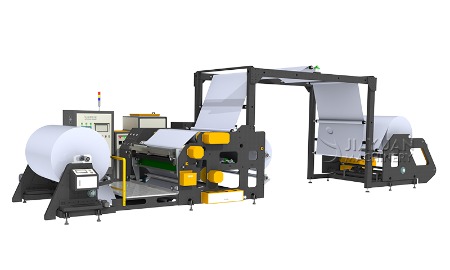
Adhesive coating machine
Key process parameters for label coating include: silicone coat weight and cure degree, adhesive coat weight, drying temperature and time, laminating nip pressure, and web tensions. The silicone coat weight is typically 0.5-1.5 gsm; too low, and the release force is too high; too high, and the silicone may migrate. The cure degree is checked by a rub test or by measuring the extractable silicone. The adhesive coat weight is set based on the label's application; for general-purpose labels, 15-20 gsm is typical; for removable labels, 10-15 gsm; for permanent labels, 25-30 gsm. The adhesive thickness is measured by a beta gauge. The drying temperature for solvent-based adhesives is 80-120°C; for water-based, 60-100°C. The residence time is determined by the oven length and speed. The laminating nip pressure is typically 20-40 N/mm; it must be uniform across the width. The web tensions are set to avoid wrinkles; the liner tension is usually higher than the face stock tension to prevent sagging. The machine's control system maintains all these parameters and provides alarms if any deviates. The quality of the label stock is tested by peel adhesion (to standard panels), tack, shear, and release force. The release force is measured by peeling the label from the liner after aging. The label stock must also have good printability and die-cuttability. The machine must be cleaned thoroughly between product changes to avoid cross-contamination of different adhesives and silicones. In summary,
label coating machines are complex systems that integrate silicone coating, adhesive coating, and lamination. Their design and operation require careful attention to each layer's properties and the interactions between them. With proper control, they produce high-quality label stock that meets the demands of the packaging and consumer goods industries.