Label Coating Machine: Troubleshooting Silicone Transfer, Adhesive Failure, and Release Issues
Label coating defects can be broadly classified into silicone-related issues, adhesive-related issues, and lamination issues. Silicone transfer is a defect where the silicone release coating migrates to the adhesive layer, reducing the label's tack and peel adhesion. This is caused by under-curing of the silicone, excessive silicone coat weight, or using an incompatible silicone/adhesive combination. The solution is to increase the curing temperature or time, reduce the silicone coat weight, or change to a silicone that is more crosslinkable. The cure degree can be verified by a solvent extraction test. If silicone transfer is detected, the affected roll may be scrapped because it cannot be reworked. Adhesive splitting occurs when the adhesive layer separates internally, leaving part on the liner and part on the face stock. This is due to low cohesive strength of the adhesive, which may result from insufficient crosslinking or too low coat weight. The solution is to increase the coat weight, adjust the crosslinker amount, or improve the drying/curing. Adhesive splitting is detected by a peel test where the adhesive splits. If it occurs, the process parameters should be reviewed. Release variation is when the release force is not consistent across the width or along the length of the roll. This is caused by uneven silicone coating, uneven curing, or variations in the liner's surface. The solution is to check the gravure cylinder for wear, inspect the oven's temperature profile, and ensure the liner is uniform. The release force is measured periodically; if it varies by more than ±10%, the process is investigated. Poor die-cutting (the label does not cut cleanly) is often due to adhesive ooze or a thick edge bead. Adjusting the coat weight and edge bead control can improve die-cutting. The label stock must have a clean edge without adhesive residue.
Adhesive failure in labels can manifest as the label peeling off prematurely (low adhesion) or as a residue left on the substrate (adhesive transfer). Low adhesion is often due to low coat weight, low surface energy of the label face (if the adhesive is applied to the face), or contamination. The solution is to increase the coat weight, treat the face stock with corona, or clean the surface. Adhesive residue (also known as "oozing" or "bleed") occurs when the adhesive is too soft or too thick, causing it to flow out from under the label. This is prevented by using a higher-viscosity adhesive, reducing the coat weight, or increasing crosslinking. The label stock should be tested for adhesive bleed by applying pressure and heat. Another issue is "label curl," where the label curls after being removed from the liner, due to differential shrinkage between the face stock and the adhesive. This is mitigated by using a face stock with low shrinkage or by adjusting the adhesive formulation. The label stock's performance is tested by applying labels to various substrates (glass, plastic, cardboard) under different conditions (temperature, humidity) to simulate real-world use. The release liner itself can cause defects; if the liner has a high coefficient of friction, it may cause the label to skew during printing. The liner's silicone coating must be smooth and free of defects. Regular cleaning of the silicone coating station and the adhesive coating head is essential to prevent contamination.
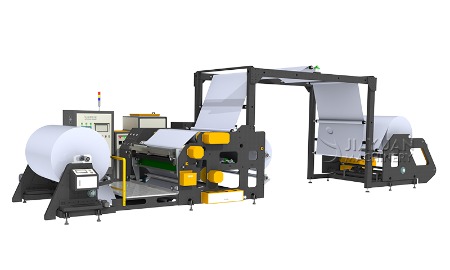
Adhesive coating machine
Troubleshooting methodology for
label coating machines: (1) Characterize the defect—peel test, visual inspection, or microscope; (2) Determine if it is silicone-related or adhesive-related; (3) Check the process parameters—temperature, speed, coat weight, pressure; (4) Inspect the coating heads—gravure cylinder, die lip, or rolls; (5) Verify the material quality—silicone, adhesive, liner, face stock; (6) Perform a root cause analysis; (7) Implement corrective action; (8) Verify the correction by running a new trial; (9) Update the standard operating procedures; (10) Train operators on the new procedures. This systematic approach reduces the time to resolve issues. Preventive measures include: regular calibration of gauges, scheduled maintenance of coating heads, and incoming quality checks on raw materials. The label coating machine's control system should have alarms for out-of-spec parameters. The operator should be trained to interpret the alarms and take appropriate action. In summary, label coating machines require meticulous process control and quality assurance to produce consistent, high-quality label stock. By understanding the common defects and their root causes, and by implementing systematic troubleshooting and preventive maintenance, manufacturers can minimize waste and deliver products that meet the stringent requirements of the labeling industry.