Lamination Machine: Nip Design, Tension Control, and Process Optimization
The nip is the defining feature of a lamination machine. It consists of two rolls—typically a steel roll and a rubber-covered roll—that press the substrates together. The nip pressure is applied by pneumatic or hydraulic cylinders on the bearing housings of the rubber roll. The pressure distribution across the nip width is determined by the roll deflection and the rubber's compliance. Under load, the rolls deflect (bend) slightly, causing lower pressure at the center if the rolls are straight. To compensate, the rubber roll is often crowned—machined with a slight increase in diameter at the center. The crown is calculated based on the roll's length, diameter, material, and the expected load. A well-crowned roll provides a uniform nip pressure profile, which is essential for consistent bonding. The rubber hardness (Shore A) affects the nip width; a softer rubber (60 Shore A) gives a wider nip but may wear faster; a harder rubber (90 Shore A) gives a narrower nip but higher pressure. The choice depends on the substrate's thickness and compressibility. For thin films, a softer roll is preferred to avoid wrinkles; for thick boards, a harder roll is used. The roll's surface must be smooth and free of defects; any imperfection transfers to the laminated product. The nip pressure is measured by load cells or pressure-sensitive film; the film shows the pressure distribution, and the operator can adjust the crown or the cylinder pressure to flatten it. Regular calibration of the load cells is necessary. The nip rolls must be perfectly parallel; misalignment causes uneven pressure and web wandering. Laser alignment tools are used to set the parallelism within 0.01 mm. The nip opening (the gap when the rolls are separated) must be set to accommodate the substrate thickness. The nip rolls are often heated (for hot-melt) or cooled (for some adhesives) by internal fluid circulation. The temperature must be uniform across the width; any variation causes differential bonding.
Tension control in a lamination machine is as important as in a coating line. The two substrates have their own unwinders, and their tensions must be controlled independently. The tension of the first substrate (the carrier) is set by its unwinder brake; the second substrate's tension is controlled by its own brake. After the nip, the laminated web is pulled by the rewinder or a pull roll. The tension must be balanced to prevent one substrate from wrinkling or stretching relative to the other. A differential tension can cause the laminated structure to curl (one layer longer than the other). To avoid this, the tensions are set so that the two substrates have similar strain. For example, if the carrier is a stiff film and the face stock is a soft film, the carrier's tension may be higher to prevent it from sagging, while the face stock's tension is lower to avoid stretching. The tension difference is often less than 10% of the mean. Dancer rolls and load cells are used to measure and control tensions. The lamination nip itself acts as a tension isolation point; the tensions before and after the nip are independent. However, if the nip pressure is too high, the rubber roll may deform and cause a speed difference, affecting tensions. Therefore, the nip pressure and the drive speeds must be coordinated. The control system uses a master speed reference and adjusts the individual drive torques to maintain the tension setpoints. During start-up, the tensions are ramped up gradually to avoid sudden strain.
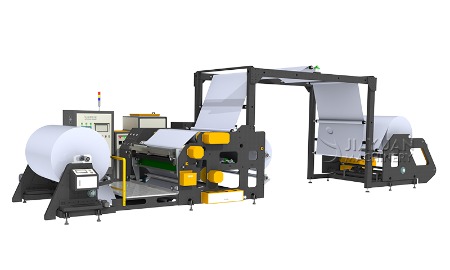
Adhesive coating machine
Process optimization of the
lamination machine involves adjusting nip pressure, temperature, and speed to achieve the best bond quality with minimal defects. A design of experiments (DOE) is conducted, varying pressure, temperature, and speed, and measuring the peel strength and appearance. The optimal point is the one that gives the highest peel strength with no bubbles or wrinkles. The relationship between pressure and bond strength is often logarithmic; beyond a certain pressure, the strength plateaus, so the minimum effective pressure is used to reduce roll wear. The temperature affects the adhesive's flow; for hot-melt, the temperature must be above the melting point but below the degradation point. The speed affects the dwell time in the nip; higher speed reduces dwell time, which may require higher temperature or pressure. The optimization is also influenced by the substrate's properties; for heat-sensitive materials, the temperature must be limited, and higher pressure may be used to compensate. The optimized settings are stored in a recipe for each product. The machine's condition should be monitored; any change in the peel strength may indicate roll wear, temperature drift, or adhesive batch variation. Regular maintenance includes cleaning the nip rolls, checking the rubber cover for flat spots, lubricating bearings, and recalibrating the pressure sensors. The operators should be trained to interpret the peel test results and adjust the settings accordingly. In summary, the lamination machine's nip and tension control are the keys to producing high-quality laminated products. By understanding the mechanics of nip pressure, the importance of roll crowning, and the interplay of tensions, operators can achieve consistent, defect-free lamination. This capability is crucial for meeting the stringent quality requirements of packaging, tape, and medical applications.