Lamination Machine: Types, Configurations, and Selection Criteria for Converting Lines
Lamination machines are essential in the converting industry for producing multi-layer structures used in flexible packaging, labels, tapes, medical devices, and decorative films. The fundamental operation is to bring two or more webs together under controlled pressure and temperature, with an adhesive layer in between. The machine consists of unwinders for each substrate, an adhesive application station (if not done in-line), a lamination nip, and a rewinder. The nip is the critical zone; it consists of a steel roll and a rubber-covered roll (or two steel rolls for some applications). The rubber roll provides compliance, ensuring uniform pressure across the web width. The lamination machine may be a "hot roll" type, where the nip rolls are heated to activate the adhesive (common for hot-melt and thermal laminating films), or a "cold roll" type, where the lamination is done at room temperature (for pressure-sensitive adhesives). "Dry bond" laminators apply adhesive, dry it, and then laminate, while "wet bond" laminators laminate immediately after adhesive application. The machine's configuration can be "roll-fed" (continuous web) or "sheet-fed" (discrete sheets). Roll-fed laminators are used for high-volume production and are often integrated into a coating line. Sheet-fed laminators are used for smaller volumes and for rigid substrates like paperboard. The selection of a lamination machine depends on the substrate width, thickness, speed, and the adhesive's processing requirements.
Hot roll laminators are commonly used for packaging films, where a thermal adhesive is applied to one film and then laminated to another at elevated temperatures (e.g., 80-150°C). The nip rolls are heated by oil circulation or electric cartridges; the temperature must be precisely controlled to avoid degrading the films. The pressure is typically 10-50 N/mm. The cooling section after the nip solidifies the bond. Hot roll laminators are also used for thermal transfer films and decorative laminates. Cold laminators use pressure-sensitive adhesives (PSAs) at room temperature; they are simpler and more energy-efficient, but the bond strength is lower and may not withstand high temperatures. Cold laminators are used for protective films, graphic overlays, and labels. Dry bond laminators are the most versatile; they coat an adhesive, evaporate the solvent/water in an oven, and then laminate the dried adhesive to the second substrate. This allows the adhesive to be fully dried, preventing solvent entrapment. Dry bond laminators are common for food packaging where solvent residue must be minimized. The machine's line speed ranges from 20 to 400 m/min, and the width can be from 0.5 to 3 meters. The unwinders and rewinders are equipped with tension control systems and edge guides. The laminating nip may have a "nip release" mechanism to allow cleaning and maintenance. The machine's frame must be rigid to maintain nip pressure uniformity; any deflection causes uneven bonding. The rolls must be balanced and ground to high precision. The machine's control system coordinates the speeds of all drives and maintains the nip pressure.
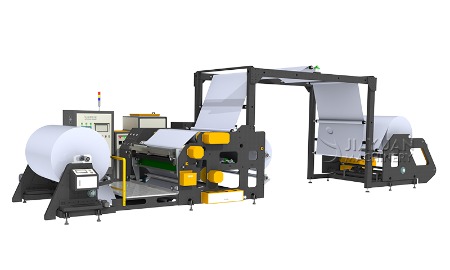
Adhesive coating machine
Selection criteria for a
lamination machine include: (1) Substrate width and thickness—the machine must accommodate the maximum width and provide adequate nip pressure for the thickness; (2) Line speed—the machine's mechanical components and control system must be capable of the desired speed; (3) Adhesive type—hot-melt requires heated rolls, solvent-based requires dry bond configuration with an oven, water-based requires corrosion-resistant materials; (4) Bond strength requirements—higher strength may require higher nip pressure and temperature; (5) Production volume—high volume justifies a more automated, robust machine; (6) Floor space—the machine's footprint must fit the facility; (7) Integration—if the lamination is in-line with coating, the machine must be synchronized with the coater; (8) Budget—the cost of the machine and its installation; (9) Maintenance—ease of roll change, cleaning, and parts availability; (10) Safety—emergency stops, guards, and fire suppression systems. It is recommended to perform trials with the candidate machine using the actual substrates and adhesives to validate its performance. The trial should include testing of bond strength, defect rate, and speed capability. The supplier should provide training and technical support. In summary, selecting the right lamination machine is a strategic decision that affects productivity, quality, and cost. By carefully evaluating the process requirements and machine capabilities, converters can choose a machine that delivers reliable, high-quality lamination for their specific applications.