Line Speed Control: Synchronization, Ramp Profiles, and Disturbance Rejection
Line speed control is achieved by a coordinated drive system that sets the speed of each driven roll in the coating line. Typically, the line has a master speed reference, which is the desired web speed. Each drive follows this reference, with a small speed offset to create the required tension between sections. The drive system consists of AC motors with variable-frequency drives (VFDs), encoders for feedback, and a PLC-based controller. The master speed is set by the operator via the HMI or from a recipe. The speed is measured by a tachometer or by the encoder of a driven roll that is in firm contact with the web. The control loop is a cascaded structure: an outer speed loop that compares the measured speed to the reference and generates a torque command, and an inner current loop that regulates the motor torque. The speed loop has a response time of about 50-100 ms. For high-speed lines (>300 m/min), the acceleration and deceleration ramps must be carefully shaped to prevent web breakage. A typical ramp rate is 10-20 m/min per second; a faster ramp can cause tension spikes that exceed the web's tensile strength. The ramp profile is often S-curve (smooth start and end) rather than linear, to reduce jerk. The acceleration is limited by the motor torque and the line's inertia; the PLC calculates the maximum allowable acceleration based on the current tension.
Synchronization between drives is critical to maintain the required tension gradient. The line is divided into tension zones: before the coater, at the coater nip, and after the coater (e.g., oven, cooling, laminator). In each zone, one or more driven rolls are operated in speed control, while others are operated in torque control to maintain tension. For example, the unwinder is often in torque control (providing a braking force) while the main pull roll is in speed control. The coater's backup roll may be in speed control, while the nip roll is in pressure control. The synchronization error between any two driven rolls must be less than 0.1% to avoid stretching or slackening. This is achieved by using high-resolution encoders (e.g., 4096 pulses per revolution) and by a high-speed communication bus (EtherCAT or SERCOS) that updates the speed references every 1 ms. The drives also have a "dancer" position controller that adjusts the speed of a driven roll to keep the dancer roll (a tension-sensing idler) at its neutral position. This provides a mechanical backup for tension control. The dancer's movement compensates for transient speed mismatches. The control system must also handle the change in roll diameter during unwinding and rewinding; as the roll diameter decreases, the peripheral speed at the same rotational speed decreases, so the drive speed must be adjusted to maintain the web speed. This is done by a diameter calculator that uses the roll's rotational speed and the line speed to compute the roll diameter, and then adjusts the drive's speed reference accordingly.
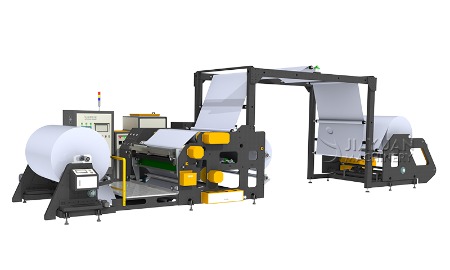
Adhesive coating machine
Disturbance rejection is a key function of the speed control system. Common disturbances include: substrate splices (which cause a short change in tension), motor power fluctuations, oven air pressure changes (which push the web), and mechanical wear of rolls. To reject these disturbances, the control system uses a combination of feedforward and feedback. For example, a splice is detected by a sensor, and a feedforward signal is sent to the tension control loop to increase the torque of the pull roll momentarily, preventing a tension drop. The feedback loop corrects any residual error. The loop gains are tuned to provide fast rejection without oscillation. In some advanced lines, an adaptive control algorithm adjusts the gains based on the process condition; for instance, if the web is thin, the gains are reduced to avoid overshoot. The speed control system also has a "jog" mode for setup and a "synchronization" mode for changing rolls. During a roll change, the line speed is reduced (e.g., to 20% of normal) to allow the splicing process; the control system must smoothly ramp down and up, with all tensions maintained. The ramp profile is stored in the recipe and executed automatically. This reduces operator intervention and ensures consistent transitions.
Practical considerations for speed control include: (1) Ensure all encoders are calibrated and have sufficient resolution; (2) Check the VFD's tuning parameters (proportional and integral gains) for each drive; (3) Monitor the motor current and torque to detect overloads; (4) Use a high-speed communication network to minimize latency; (5) Implement a "load sharing" function if multiple motors drive the same roll; (6) Regularly inspect the belts, gears, and couplings for wear that could cause speed errors; (7) Use a simulation tool to test the ramp profiles and find the optimal settings; (8) Train operators on the interpretation of speed and tension alarms. The speed control system is also integrated with the coat weight control: a change in speed triggers a feedforward adjustment of the pump speed to maintain the coat weight. This is done by a "ratio control" where the pump speed is set as a fixed ratio of the line speed. The ratio is adjusted by the coat weight feedback loop. Therefore, the speed control and coat weight control are interdependent. A well-designed control system coordinates them seamlessly. In summary, line speed control is a sophisticated engineering discipline that ensures the web moves smoothly and accurately through the coating line. By achieving precise synchronization, robust disturbance rejection, and smooth ramp profiles, the coating line can operate at high speeds with minimal defects and breaks, maximizing productivity and quality. The advances in drive technology and control algorithms continue to push the speed envelope, enabling ever-faster coating lines.