Line Speed in Coating: Limits, Dynamics, and Optimization for Productivity
Line speed is the velocity at which the substrate travels through the coating line. It directly determines the throughput: higher speed means more square meters produced per hour, reducing the unit cost. However, increasing speed also intensifies all process challenges. The maximum speed is constrained by several physical and mechanical limits. The drying capacity is often the dominant bottleneck: the oven must evaporate the solvent at a rate equal to the coating application rate. The drying rate is limited by the heat input and the mass transfer coefficient; if the speed is too high, the coating will not dry completely, leading to residual solvent, blocking, or blistering. For a given oven length and temperature, the maximum speed is inversely proportional to the wet coat weight. For example, a 30-meter oven at 120°C might support 200 m/min for a 20 gsm coating, but only 100 m/min for a 40 gsm coating. The air entrainment limit is another fluid-dynamic constraint: at high speeds, the boundary layer of air on the substrate becomes thicker and can be entrained into the coating bead, causing pinholes and streaks. This limit is roughly proportional to the fluid's viscosity and inversely proportional to the die gap. For low-viscosity fluids, air entrainment is less of a problem, so speeds can be higher.
Bead stability in slot-die and roll coating is also speed-dependent. At high speeds, the hydrodynamic pressure in the bead increases, which can destabilize the menisci, leading to dripping or bead break. The vacuum level must be increased to stabilize the bead, but if the vacuum is too high, it can pull the web upward. There is an optimal vacuum for each speed; as speed increases, the vacuum must be adjusted accordingly. The coating window, as mentioned earlier, is a region in the speed-flow plane; the maximum speed is the upper boundary of this window for a given flow rate. In gravure coating, the speed is limited by the transfer efficiency; at very high speeds, the cells may not empty completely, reducing coat weight, and the impression roll may slip. Mechanical constraints include the maximum rotational speed of rolls, the bearing load limits, and the vibration modes of the machine frame. As speed increases, the centrifugal forces on the rolls increase, which can cause deflection and vibration. The machine's critical speeds—the rotational speeds at which natural frequencies are excited—must be avoided. Typically, the machine is designed to operate below the first critical speed, or it is balanced to operate above it. The web handling also becomes more challenging; tension control must be faster, and web breaks become more frequent if the tension is not well managed. Therefore, the maximum speed is the minimum of all these limits.
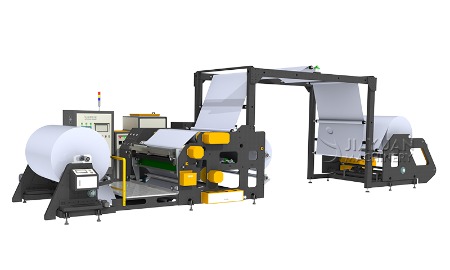
Adhesive coating machine
Optimizing line speed involves finding the speed that maximizes profit per hour, not necessarily the highest speed. As speed increases, defect rate may increase, requiring more scrap. The relationship between speed and defect rate is often a convex curve: defects are low at moderate speeds but rise sharply at high speeds. The economic optimum is where the marginal gain in throughput equals the marginal cost of scrap and rework. To find this, one must conduct a speed-ramp test: increase the speed in steps, hold each speed for a sufficient time to collect defect data, and measure the resulting yield and quality. The data is plotted, and the optimum is identified. In some cases, the optimum is not the maximum speed; for example, a 10% speed increase might cause a 20% increase in defects, reducing net good output. In such cases, a lower speed is more profitable. Also, the drying cost increases with speed because more energy is needed to evaporate the same amount of solvent in a shorter time; the energy cost per square meter may increase slightly. The optimization model should include energy cost, material cost, scrap cost, and maintenance cost. This holistic view yields the optimal speed. In practice, many lines operate at 80-90% of the maximum speed to allow a safety margin for disturbances.
Practical strategies to increase line speed without sacrificing quality include: upgrading the oven with higher-velocity impingement air or IR pre-heaters to increase the drying rate; using a higher-solids coating fluid to reduce the wet thickness and thus the drying load; improving the bead stability by using vacuum assist or a wider die gap; reducing the substrate's boundary layer by using an air knife before the coating head; improving the web tension control with faster actuators; and balancing the rolls to reduce vibration. Each improvement has a cost; the economic feasibility is assessed by calculating the payback. For example, installing a new high-impingement oven may cost $500,000 and allow a 30% speed increase, which could add $200,000/year in profit, giving a payback of 2.5 years. This is often acceptable. The speed increase should be validated by a full-scale trial with all quality tests. Also, the operator's training must be updated to handle the new speed; faster lines require quicker responses and more attentive monitoring. In some plants, the speed is gradually increased over a period of months, with each step carefully analyzed. This incremental approach reduces risk and builds operator confidence. The final speed achieved is documented in the product recipe.
Case examples: In a PSA tape line, the speed was increased from 150 to 200 m/min by adding an IR pre-heater and adjusting the vacuum. The drying was still sufficient, and the edge bead was controlled, resulting in a 33% increase in throughput. In a battery electrode line, the speed was limited by drying; by switching to a higher-solids slurry (from 50% to 55% solids), the wet thickness was reduced, allowing the speed to increase from 40 to 55 m/min without oven modifications. In an optical film line, the speed was limited by air entrainment; by reducing the die gap and increasing the vacuum, the speed was increased from 80 to 110 m/min. Each case demonstrates that line speed optimization is a multi-faceted engineering activity. It requires a thorough understanding of the coating physics, the machine capabilities, and the product quality requirements. The ultimate speed is a moving target, as improvements in materials, controls, and hardware continue to push the boundaries. In summary, line speed is a critical parameter that must be carefully optimized, not simply maximized. By using a systematic, data-driven approach, coating lines can achieve the speed that delivers the best balance of productivity, quality, and cost, ensuring long-term competitiveness.