Low Viscosity Coating: Advanced Vacuum Systems, Surfactant Optimization, and High-Speed Operation
The vacuum system in slot-die coating is critical for low-viscosity fluids. The vacuum box is positioned downstream of the die; it applies a negative pressure that reduces the pressure in the bead, stabilizing it. The vacuum level is typically 5-50 mbar, depending on the fluid and the speed. The vacuum must be uniform across the width; any non-uniformity causes a non-uniform bead. The vacuum box is equipped with a pressure sensor and a control valve; the control system adjusts the vacuum in real-time based on the bead's stability (observed by a camera) or the coat weight profile. The vacuum system must also remove any solvent vapors; an exhaust line is connected to a solvent recovery system. For high speeds, the vacuum level must be increased; however, excessive vacuum can cause the web to flutter. The vacuum box is designed with a curved slot to match the web's path. In summary, the vacuum system is a key enabler for high-speed, low-viscosity slot-die coating.
Surfactants are additives that lower the surface tension of the coating fluid, improving wetting and bead stability. The optimal surfactant concentration is determined by the surface tension required for the substrate. Too little surfactant causes de-wetting; too much can cause foam, reduce adhesion, or affect the coating's properties. The surfactant is added to the formulation during mixing; its concentration is verified by measuring the surface tension of a sample. Inline surface tension sensors are available, but they are not common. The operator should monitor the wetting by visual inspection and adjust the surfactant concentration if needed. Some surfactants are volatile and may evaporate during the process; a recirculation system can help maintain the concentration. In summary, surfactant optimization is essential for achieving defect-free wetting in
low viscosity coatings.
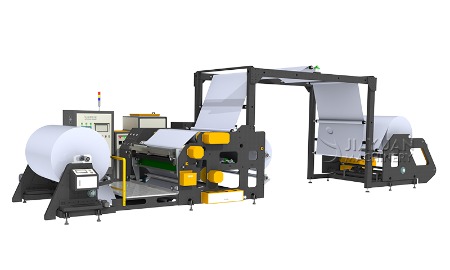
Adhesive coating machine
Air entrainment is a major defect in low viscosity coating at high speeds. The substrate carries a layer of air (the boundary layer) that can be dragged into the coating bead, forming bubbles that appear as pinholes. The critical speed for air entrainment is proportional to the fluid's viscosity and inversely proportional to the surface tension. For low-viscosity fluids, the critical speed is high (often >500 m/min), but at very high speeds, it can become a limit. To prevent air entrainment, the die-to-web gap is reduced, the vacuum is increased, and the substrate is pre-wet with a thin layer of solvent. Some systems use an air knife to blow off the boundary layer before the coating bead. The web's surface roughness also affects air entrainment; smoother webs are more prone. In summary, air entrainment is managed by optimizing the gap, vacuum, and web preparation.
Inline quality sensors for low viscosity coating include thickness gauges, defect cameras, and surface tension sensors. The thickness gauge provides the coat weight; the defect camera detects pinholes, streaks, and de-wetting; the surface tension sensor (if available) monitors the fluid's wetting ability. The data from these sensors is fed into a data analytics system that uses machine learning to predict defects and to recommend adjustments. For example, if the surface tension is too high, the system suggests adding surfactant; if the coating thickness varies, it suggests adjusting the pump speed or the vacuum. The system can also correlate defects with process parameters to identify the root cause. This proactive approach reduces waste and improves quality. In conclusion, low viscosity coating can be optimized for high-speed, high-quality production by integrating advanced vacuum systems, surfactant management, air entrainment prevention, and inline analytics. With these technologies, manufacturers can achieve consistent, defect-free thin coatings at competitive speeds, meeting the demands of the packaging, printing, and electronics industries.