Low Viscosity Coating: Principles, Challenges, and Process Control for Thin, Water-Like Fluids
Low viscosity coating is used for a wide range of applications: solvent-based lacquers for packaging, water-based primers, inks for printing, and functional coatings for electronics. The low viscosity allows the fluid to flow easily, which is good for leveling, but it also presents challenges: the coating bead is unstable, the fluid may de-wet from the substrate, and the drying is fast, which can cause defects. The coating head must be designed to handle the low viscosity. Gravure coating is a common method; the engraved cylinder transfers the fluid, and the doctor blade removes excess. Slot-die coating with a vacuum assist is also used; the vacuum stabilizes the bead, which would otherwise break easily. Spray coating is used for 3D surfaces. The key to successful low viscosity coating is controlling the surface tension, the substrate's surface energy, and the web speed to avoid air entrainment and to ensure uniform wetting. In summary, low viscosity coating requires careful attention to fluid dynamics and surface chemistry.
The coating bead in slot-die coating is particularly sensitive to low viscosity. The bead is a liquid bridge between the die lip and the web. For low-viscosity fluids, the capillary forces are weak, and the bead can easily break or pull back. To stabilize the bead, a vacuum box is placed downstream to apply a negative pressure; the vacuum level must be carefully adjusted—too low, and the bead breaks; too high, and the web is pulled up. The die-to-web gap is also smaller (0.1-0.3 mm) to reduce the bead's height. The die angle (the angle between the die and the web) is set to optimize the bead shape. The fluid's surface tension also affects the bead; a lower surface tension makes the bead more stable. For gravure coating, the low viscosity allows the cells to fill and empty quickly, enabling high speeds. The doctor blade pressure must be low to avoid damaging the cylinder. In summary,
low viscosity coating requires precise control of the bead and the fluid's surface properties.
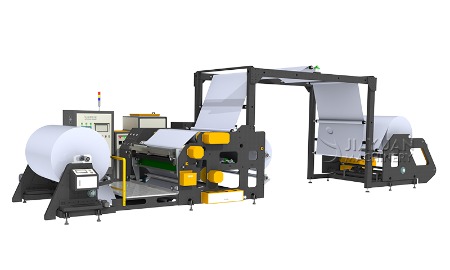
Adhesive coating machine
Wetting and leveling are critical for low viscosity coatings. The fluid must spread uniformly on the substrate; if the substrate's surface energy is lower than the fluid's surface tension, the fluid will de-wet, forming droplets or bare spots. To prevent this, the substrate is corona-treated or primed to increase its surface energy. The fluid's surface tension can be lowered by adding surfactants, but this may affect the coating's properties. The leveling—the flow of the fluid to eliminate surface irregularities—is excellent for low-viscosity fluids because they flow readily. However, if the drying is too fast, the fluid may not have time to level, leading to orange peel. The drying profile should be designed to allow some time for leveling before the solvent evaporates. In summary, wetting and leveling are optimized by matching the surface energies and by controlling the drying rate.
Drying of low viscosity coatings is fast because the solvent content is high and the coat weight is low. This can be an advantage for high speeds, but it can also cause defects: skinning (a surface film that traps solvent), blistering (if the solvent evaporates too quickly), and orange peel (if the leveling is incomplete). The oven temperature profile should be gentle in the first zone to allow leveling, then higher for bulk evaporation. The airflow should be sufficient to remove the solvent vapor but not so high that it disturbs the wet film. The residual solvent must be below the specified limit. In summary, the drying process must be optimized to balance speed and quality.
Quality control for low viscosity coatings includes measuring the coat weight (often thin, 1-10 gsm), the surface tension, and the wetting. The coat weight is measured by a beta or X-ray gauge; optical methods can also be used. The surface tension is measured by a tensiometer; if it changes, the wetting may change. The substrate's surface energy is checked with dyne pens. The coating's appearance is inspected for streaks, pinholes, and de-wetting. The operator should adjust the process parameters based on the quality data. In conclusion, low viscosity coating is a fine balance between fluid properties, process parameters, and substrate characteristics. By understanding the physics and chemistry, manufacturers can achieve high-quality, thin coatings for a wide range of applications, from packaging to electronics.