Medical Tape Coater: Adhesive Formulations, Substrate Selection, and Performance Testing
Medical tapes use a variety of adhesive formulations, each with specific properties. Acrylic PSAs are the most common; they offer good adhesion to skin, high cohesive strength, and resistance to body fluids. They are typically water-based or solvent-based; water-based acrylics are preferred for medical use due to lower toxicity. The acrylic polymer is formulated with soft monomers (to increase tack) and hard monomers (to increase cohesion). The coat weight is usually 20-30 gsm. Silicone PSAs are used for tapes that need gentle adhesion, such as for sensitive skin or for wound dressings that require frequent changing. Silicone adhesives have low adhesion to skin, are breathable, and do not irritate. They are applied from solvent solutions and require special curing. Hydrogel adhesives are used for electrodes and drug delivery patches; they are highly hydrophilic and provide a moist environment for the skin. Hydrogel adhesives are coated by slot-die or knife-over-roll; they are sensitive to drying conditions. The choice of adhesive depends on the application: high adhesion for surgical tapes (need to hold devices), low adhesion for neonatal tapes, and moderate adhesion for wound dressings. The adhesive must pass biocompatibility tests (ISO 10993) for cytotoxicity, sensitization, and irritation. The adhesive's rheology is tailored to provide the right balance of tack, peel, and shear. The adhesive supplier provides the formulation and the recommended processing conditions. The medical tape coater must handle the adhesive's specific viscosity and drying requirements.
Substrate selection is equally important. The backing must be flexible, breathable, and conformable to skin. Nonwoven fabrics (e.g., spunbond polyester, rayon) are breathable and soft, making them comfortable for extended wear. Microporous films (e.g., polyethylene, polyurethane) are also breathable and provide barrier properties. Foam backings are used for cushioning and absorbing impacts, such as in sports tapes. The substrate's surface energy must be high enough to bond with the adhesive; many substrates require corona or primer treatment. The substrate's thickness and stiffness affect the tape's handling and application. For double-sided medical tapes, a release liner is required on both sides; the liner is typically a silicone-coated paper or film. The substrate must be sterile (or sterilizable) and free of contaminants. The substrate's breathability is measured by the Moisture Vapor Transmission Rate (MVTR); a high MVTR is preferred to prevent skin maceration. The substrate's tensile strength must be sufficient to withstand the application and removal forces. The
medical tape coater must be able to handle the specific substrate without stretching or wrinkling; this requires gentle tension control and proper web guiding. The substrate's roll weight and diameter must be within the machine's capacity. In summary, the substrate is not just a carrier but an active component of the tape's performance. Its selection must be coordinated with the adhesive and the intended use.
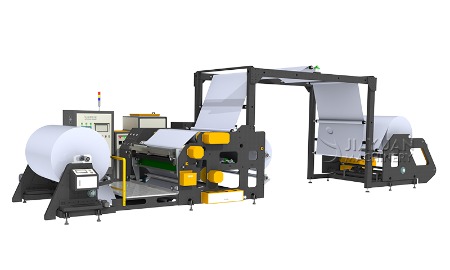
Adhesive coating machine
Performance testing of medical tapes is comprehensive and follows standard protocols. Peel adhesion is measured by applying the tape to a standard test panel (typically stainless steel) and peeling at 180° or 90° at a specified speed. The result is the force per width (e.g., N/cm). For skin adhesion, human volunteer testing is often required; the tape is applied to the back or forearm and removed after a defined time, and the force is measured. Tack is measured by a probe tack or loop tack test; it indicates the initial grab. Shear adhesion is measured by applying a static load to the tape and recording the time to failure; it indicates the adhesive's internal strength. Release force is measured by peeling the tape from its release liner. In addition to mechanical properties, the tape is tested for breathability (MVTR), water resistance, and microbial barrier. The tape's aging stability is tested by accelerated aging at elevated temperature; the adhesion should not decrease significantly. Skin irritation and sensitization are tested on animal models or human volunteers according to ISO 10993. The tape must also be tested for cytotoxicity (cell culture) and biocompatibility. All these tests require specialized equipment and trained personnel. The results are documented in the technical file for regulatory submission. The medical tape coater's process must be validated to produce tapes that consistently pass these tests. If a test fails, the root cause is investigated and corrective action is taken. In some cases, the formulation or the process may need to be modified. The cooperation between the adhesive supplier, the substrate supplier, and the coating machine operator is essential for success.
Optimization of medical tape performance involves balancing adhesion, removability, and skin compatibility. A common trade-off is between high adhesion (which ensures the tape stays in place) and low trauma upon removal (which minimizes skin damage). To achieve this, the adhesive coat weight and formulation are adjusted; for example, adding a silicone additive can reduce the peel force. The substrate's flexibility also affects the removal force; a softer substrate reduces the force needed to peel. The drying conditions can affect the adhesive's crosslinking and thus its adhesion; over-drying can reduce tack, under-drying can cause residue. The laminating pressure and release liner properties affect the transfer of the adhesive to the face stock; the release force must be optimized. All these variables are explored in a design of experiments (DOE) to find the optimal combination. The final product is then tested under simulated use conditions (e.g., on human skin). The medical tape coater must be capable of making the adjustments required by the DOE. The operator must be trained to interpret the test results and adjust the process accordingly. In conclusion, medical tape coating is a multidisciplinary field that integrates chemistry, materials science, and process engineering. By carefully selecting the adhesive and substrate, optimizing the process, and rigorously testing the product, manufacturers can produce medical tapes that are safe, effective, and comfortable for the patient. This commitment to quality is what distinguishes medical tape coaters from general-purpose coating lines.