Medical Tape Coater: Design, Regulatory Requirements, and Process Validation
Medical tape coaters are a distinct category of coating equipment that must meet stringent regulatory and quality standards. Medical tapes are used on human skin, so they must be biocompatible, non-irritating, and sterile (or sterilizable). The adhesive used is typically a hypoallergenic acrylic or silicone-based PSA, which must pass cytotoxicity, sensitization, and irritation tests (ISO 10993). The substrate (backing) is often a breathable material like nonwoven fabric, microporous film, or foam, which allows moisture vapor transmission to prevent skin maceration. The coating line must be designed for cleanroom operation (Class 100,000 or better) to minimize contamination. The machine is typically all-stainless-steel or coated to resist corrosion from cleaning agents. The coating head can be slot-die, roll, or gravure; slot-die is preferred for its high precision and low solvent emission. The adhesive coat weight for medical tapes is usually 15-30 gsm, depending on the application (e.g., wound dressings: 20-25 gsm; surgical tapes: 15-20 gsm). The line speed is generally slower than industrial lines (20-100 m/min) to allow careful control and inspection. The drying oven must be designed to avoid overheating the substrate; temperature is typically 40-80°C for water-based adhesives. Solvent-based adhesives are rare in medical tapes due to toxicity concerns. The machine includes a laminating station for applying a release liner (usually a siliconized paper or film) and a rewinder for the finished rolls. The entire line must be validated according to FDA guidelines (Process Validation) and ISO 13485.
Regulatory compliance is a major driver in medical tape coating. The machine must be designed to facilitate cleaning and sanitation to prevent microbial contamination. The surfaces that contact the product must be smooth and non-porous. The adhesive and substrate must be traceable; the machine should have a system for tracking batch numbers and production dates. The control system must have data logging capabilities to record all process parameters (temperature, speed, pressure, coat weight) for each batch. This data is part of the Device History Record (DHR). The coating line must undergo Installation Qualification (IQ), Operational Qualification (OQ), and Performance Qualification (PQ) as part of process validation. IQ verifies that the machine is installed according to specifications; OQ tests the machine's functionality; PQ demonstrates that the machine consistently produces tapes that meet the specifications. The validation must be re-performed whenever there is a major change in the machine or the process. The machine must also have safety features for the operators, such as emergency stops and guards. The coating line is often located in a controlled environment with HEPA filters and positive pressure. The operators must wear cleanroom garments and follow strict hygiene protocols. The quality management system (QMS) includes procedures for change control, non-conformance, and corrective action. All these requirements add complexity and cost to the
medical tape coater, but they are essential for ensuring patient safety and regulatory approval.
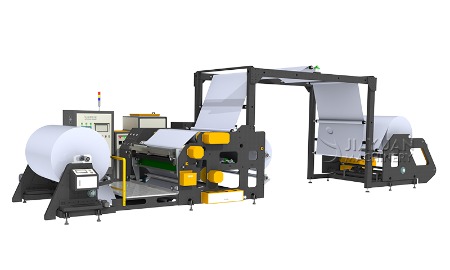
Adhesive coating machine
The coating process for medical tapes must be optimized to produce a consistent adhesive layer with minimal defects. The adhesive coat weight is critical because it affects the tape's adhesion to skin and its removal force. Too high a coat weight can cause skin irritation upon removal; too low can cause the tape to fall off. The coat weight is controlled by the pump speed and the die gap; it is measured online by a beta gauge. The drying profile must be gentle to preserve the adhesive's softness and tack. For water-based adhesives, the oven has multiple zones with controlled temperature and humidity. The adhesive must be fully dried to avoid solvent residue, which could cause skin irritation. The lamination of the release liner must be done without trapping air bubbles; a smooth nip roll is used. The release liner must have a consistent release force to ensure easy peeling of the tape from the liner. The release force is tested according to ASTM standards. The finished rolls are inspected for defects using a camera system; any defect is marked and removed. The tape is then cut into smaller rolls or sheets, packed, and sterilized (if required). The sterilization method (e.g., ethylene oxide, gamma radiation) must be compatible with the adhesive and substrate. The medical tape coater is thus part of a broader manufacturing system that includes converting, packaging, and sterilization. The entire system must be operated and maintained according to Good Manufacturing Practices (GMP).
Process validation for medical tape coating involves three stages: process design, process qualification, and continued verification. In process design, the critical process parameters (CPPs) are identified, such as coat weight, oven temperature, and laminating pressure. The critical quality attributes (CQAs) are defined, such as peel adhesion, tack, and release force. Then, a series of experiments (DOE) is conducted to determine the acceptable ranges of the CPPs that produce the CQAs within specifications. The process qualification stage involves running three consecutive batches at the nominal conditions to demonstrate reproducibility; the batches must pass all quality tests. The continued verification involves ongoing monitoring of the process parameters and product quality; SPC charts are used to detect any trends. If a trend indicates a process shift, corrective action is taken. The validation documentation is reviewed by regulatory authorities during inspections. The medical tape coater must also be qualified for the specific adhesive and substrate combination; each new product requires its own validation. The machine's maintenance schedule is strictly followed; any maintenance that affects the process (e.g., replacing a roll) must be followed by re-qualification. In summary, medical tape coaters are highly regulated, precision machines that require a rigorous approach to design, operation, and validation. By adhering to these standards, manufacturers can produce safe, effective, and reliable medical tapes that meet the needs of healthcare professionals and patients.