Nonwoven Coating: Defect Diagnosis, Quality Assurance, and Sustainability Trends
Defects in nonwoven coating can be costly, as they lead to product rejection and rework. Common defects include adhesive bleed-through, where the adhesive penetrates the fabric and stiffens it, causing skin irritation in hygiene products. This is caused by low viscosity or excessive coat weight; reducing the coat weight or using a higher-viscosity adhesive solves it. Stringing—the formation of fine adhesive threads—is a frequent issue in spray coating; it results from high temperature or excessive air pressure. Lowering the temperature by 5-10°C and adjusting air pressure can eliminate stringing. Poor bond strength, where layers separate, is due to insufficient coat weight or incorrect adhesive formulation; increasing the coat weight or changing the adhesive's tackifier level may help. Pattern inconsistency, such as missing spray or uneven strips, is often caused by clogged nozzles or pump pulsation; regular cleaning and using a pulse dampener are corrective. Edge ooze, where adhesive extrudes beyond the coating width, is managed by precise edge masking or die gap tapering. Wrinkling of the nonwoven during coating is due to uneven tension; using a spreader roll and proper tension control eliminates it. A systematic approach: characterize the defect, check process parameters, inspect the coating head, verify the adhesive quality, and implement corrective action. The defect log should be maintained to correlate issues with specific conditions. Preventive measures include routine cleaning, filter changes, and calibration of sensors.
Quality assurance for nonwoven coating involves both in-line and off-line testing. In-line, the coat weight is monitored by a gauge; the adhesive pattern is inspected by a camera system. Off-line, the coated fabric is tested for peel strength (the force to separate bonded layers), bond strength (tensile test), and stiffness (handle-o-meter or bending length). For hygiene products, the coating must pass skin compatibility tests (irritation, sensitization) and must not transfer to the skin. The breathability (MVTR) is measured to ensure the coating does not compromise the fabric's moisture vapor transmission. Accelerated aging tests (heat, humidity) are conducted to verify the bond's durability over the product's shelf life. The coating's resistance to fluids (saline, urine) is tested for diaper applications. All tests are performed according to ISO or ASTM standards. The data is analyzed using SPC; control charts monitor the coat weight and bond strength. If a trend indicates a shift, the process is investigated. The quality assurance system must be compliant with ISO 9001 and, for medical nonwovens, ISO 13485. The documentation includes batch records, test results, and corrective actions. In summary, rigorous quality assurance ensures that coated nonwovens meet the performance and safety requirements of their end-use applications, building trust with customers and regulators.
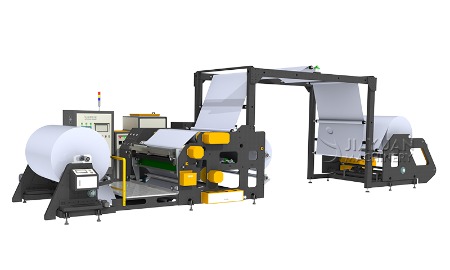
Adhesive coating machine
Sustainability is transforming
nonwoven coating. The industry is moving towards bio-based adhesives derived from plant oils, starches, and natural resins. These adhesives have a lower carbon footprint and are often compostable. However, they may have different thermal stability and tack profiles; the coating process must be adapted with lower temperatures and modified pump settings. The use of recycled nonwoven substrates is also increasing; however, recycled fibers may have contaminants that affect coating adhesion, so enhanced filtration and surface treatment are needed. The trend towards thinner, more efficient coatings reduces material usage and waste. Some manufacturers are developing solvent-free, 100% solid hot-melts with reduced viscosity for better sprayability at lower temperatures, saving energy. The coating line itself is being designed for energy efficiency with improved insulation and heat recovery. In addition, the end-of-life of coated nonwovens is being addressed; recyclable mono-material systems (e.g., all-polypropylene) that can be recycled are being developed, where the adhesive is compatible with the polypropylene recycling stream. The coating equipment must be flexible to handle these new materials; quick-change die systems and modular coating heads are becoming common. Sustainability is not just a trend but a business imperative, driven by consumer demand and regulatory pressures. In conclusion, nonwoven coating is evolving towards higher performance, lower environmental impact, and greater recyclability, and the coating industry must adapt to these changes through innovation and collaboration with material suppliers.