Nonwoven Coating: Technologies, Adhesive Systems, and Process Control for Hygiene and Industrial Fabrics
Nonwoven fabrics are engineered materials made from fibers bonded together by mechanical, thermal, or chemical means. They are widely used in disposable diapers, feminine hygiene products, medical gowns, wipes, and industrial filters. Coating nonwovens adds functionality: it can provide liquid barrier, enhance softness, improve bonding to other layers, or impart antimicrobial properties. The coating process must be gentle because nonwovens are delicate, highly porous, and may have low tensile strength. The most common coating methods are spray coating (spiral or slot spray), slot-die coating, gravure coating, and foam coating. Spray coating is popular for its ability to apply low coat weights (1-5 gsm) in a wide pattern without compressing the fabric. Slot-die coating offers precise, uniform application for higher coat weights (5-30 gsm) and is used for barrier coatings. Gravure is used for thin, uniform layers (0.5-3 gsm) of release or primer coatings. Foam coating applies a foam of adhesive or binder, which penetrates the fabric for core bonding. The choice depends on the substrate's basis weight (10-200 gsm), the required coat weight, and the line speed (up to 600 m/min). The coating must maintain the fabric's breathability and softness, which are critical for hygiene products.
Hot-melt adhesives are the dominant system for nonwoven coating, especially in hygiene applications. They are applied molten at 120-170°C and solidify upon cooling, forming a flexible bond. Formulations are based on styrenic block copolymers (SIS, SBS) with tackifiers and plasticizers. For spray application, the adhesive is atomized by air to create a spiral or random pattern. The coat weight is controlled by the pump flow rate and the line speed; typical values are 1-5 gsm for construction bonding. For slot-die application, the adhesive is extruded as a continuous film or strip; coat weights range from 3-30 gsm for barrier or laminating coatings. Water-based adhesives (acrylic emulsions) are used for some medical and industrial applications where solvent-free and low-odor coatings are needed. They require drying ovens (60-100°C) to remove water. Silicone coatings are used for release liners on nonwovens, applied by gravure or slot-die and cured by heat or UV. The adhesive system must be compatible with the nonwoven's fiber composition (polypropylene, polyester, rayon) and any additives. The coating line must have precise temperature control for hot-melt and careful humidity control for water-based systems. The adhesive supply system includes melters, heated hoses, and filters, with pumps that provide pulse-free flow.
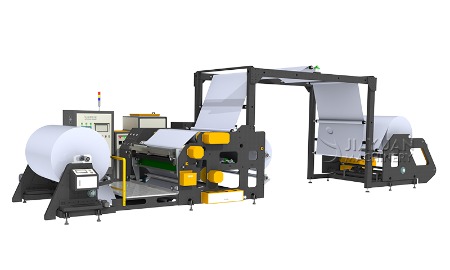
Adhesive coating machine
Process control for
nonwoven coating is challenging due to the porous and compressible nature of the substrate. The coat weight must be uniform; variations cause weak spots or stiffness. Online gauges (beta, NIR, or optical) measure the coat weight and provide feedback to the pump speed. For spray coating, the pattern width and thread thickness are controlled by air pressure and nozzle design; a vision system inspects the pattern for defects such as missing threads or excessive stringing. The web tension must be low to avoid stretching the nonwoven; dancer rolls and load cells maintain constant tension. The substrate's moisture content affects its behavior; conditioning is needed in some cases. The drying or cooling section must be optimized: for hot-melt, a chill roll or cooling air solidifies the adhesive; for water-based, a flotation or through-air oven dries the coating without contact. The oven's airflow must be gentle to prevent fabric deformation. The coating head must be easily cleaned to prevent adhesive buildup, which can cause streaks. Regular maintenance of nozzles, dies, and pumps is essential. The machine's control system stores recipes for each product, including temperature setpoints, pump speeds, and air pressures. Operators must be trained to adjust parameters based on the fabric's properties. In summary, nonwoven coating is a specialized process that demands careful control of adhesive rheology, application method, and substrate handling to achieve the required functional properties while preserving the fabric's inherent qualities.