PSA Coating Machine Line Integration: From Unwind to Slitting
A complete PSA coating machine line is a continuous sequence of modules, each critical to the final product. The line starts with the unwinding station, where the substrate (e.g., PET film, paper, or release liner) is mounted on a shaft and fed into the machine. Unwinders are typically equipped with automatic tension control and splice tables to allow roll changes without stopping. For sensitive films, low-tension unwinding with dancer rolls and load cells ensures no stretching. The substrate then passes through a cleaning and pretreatment section, which may include brushes, ionizing bars, and corona treaters. Corona treatment is essential for non-polar films to ensure adhesive wetting; its effectiveness is measured by water contact angle or dyne level. Proper pretreatment can double the adhesion strength. After treatment, the web enters the coating station, where the PSA is applied.
The coating station is the core, and its design varies as discussed earlier. For slot-die coating, the die is mounted on a precision carriage with micrometer adjustments for gap and angle. The pump feeds adhesive from a tank that may be heated, stirred, and degassed. The die-to-web gap is set based on wet thickness and line speed; a vacuum box behind the die helps stabilize the liquid bead. For gravure coating, the engraved roll rotates in a pan of adhesive, and a doctor blade scrapes excess. The impression roll presses the substrate onto the engraved roll to pick up the pattern. Both methods require precise synchronization between the coating head and the drive system. Immediately after coating, the web enters the drying or cooling zone. Solvent and water-based lines have long ovens with multiple zones; hot-melt lines have chill rolls. The temperature profile in the oven must be tuned to the solvent's boiling point and the adhesive's heat sensitivity. Infrared pre-heaters can speed up the initial temperature rise.
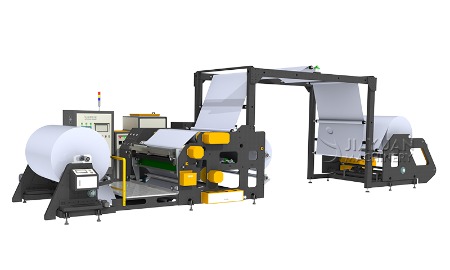
Adhesive coating machine
After drying/cooling, the coated web may pass through a laminating station where a release liner or a second substrate is pressed onto the adhesive. For transfer-coated tapes, the adhesive is first coated on a release liner, dried, and then laminated to the face stock. This laminating nip uses rubber-covered steel rolls with controlled pressure and temperature. Air entrapment is a common problem; using a smooth, polished nip roll and adjusting the nip angle helps. After lamination, the web goes through a cooling section to stabilize temperature before winding. An edge trimmer may cut off the edges to eliminate bead or uneven width. The trimmed edges are often recycled or ground for reprocessing (for hot-melt). Then, an inspection system scans the full width using laser or camera technology to detect pinholes, streaks, and contamination. Defective areas are flagged or automatically marked for rejection later.
The rewinder is the final module, winding the finished product into rolls of specified diameter and length. Turret rewinders allow continuous operation by rotating between full and empty cores. Tension control during winding is critical: too high tension causes blocking (adhesive sticking to backing) or telescoping; too low leads to loose rolls. Center-driven or surface-driven winding methods are chosen based on substrate stiffness and roll hardness requirements. For very adhesive products, a slip sheet or interleaving paper may be inserted during winding. Also, the rewinder may have a slitting section just before winding to cut the wide master roll into multiple narrow rolls. Slitting can be razor, shear, or crush type, each suitable for different substrates. Razor slitting is common for thin films; shear slitting for paper. Accurate slitting width and clean edges are essential for customer satisfaction. All these modules communicate via a fieldbus network, and the central control panel displays real-time status.
Integration challenges include coordinating the acceleration and deceleration of all drives to prevent web breaks or coat weight spikes. The line control system must handle ramp-up and ramp-down profiles smoothly. Also, web splices—when a new roll is joined to the old—can cause temporary defects; a splice detection sensor triggers a marker on the roll so that the defective portion can be removed later. Many lines include a storage accumulator (festoon) that allows the line to continue during a splice, minimizing waste. Changeover from one product to another requires cleaning the coating head, oven, and piping, which can take several hours. Quick-change die designs and solvent flush systems reduce this downtime. Furthermore, the line must comply with safety standards: emergency stops, pull-cords, light curtains, and fire extinguishing systems are mandatory. Regular risk assessments and safety audits are conducted. To maximize overall equipment effectiveness (OEE), predictive maintenance and spare parts inventory management are crucial. By integrating all these modules seamlessly, a
PSA coating machine line achieves high throughput, consistent quality, and low scrap, making it a competitive asset in the converting industry.