PSA Coating Machine Technology: From Hot-Melt to Solvent-Based Systems
Pressure sensitive adhesive coating machines are engineered to handle three main adhesive families: solvent-based, water-based, and hot-melt. Each system has distinct mechanical and process requirements. Solvent-based PSA machines are the traditional workhorse for high-performance acrylics and rubber adhesives. They require explosion-proof electrical components, inert gas purging, and sophisticated solvent recovery units (carbon adsorption or thermal oxidation). The coating head is usually a slot-die or gravure, with the die often jacketed for temperature control. Ovens are long, with high air turnover rates and LEL (lower explosive limit) monitors. These machines can produce very thin, uniform coatings with excellent clarity and aging resistance. However, they have high capital and operational costs due to solvent handling and regulatory compliance. Water-based PSA machines use emulsions of acrylic or styrene-butadiene rubbers. They are safer and more environmentally friendly but need longer drying ovens because water has a higher latent heat of vaporization. The ovens must manage high humidity and prevent condensation. Corrosion-resistant materials (stainless steel) are used in the wet section. Coat weights are generally higher than solvent-based to achieve equivalent performance, and the adhesives are more shear-sensitive, requiring gentle pumping (peristaltic or low-shear gear pumps).
Hot-melt PSA coating machines are rapidly gaining popularity due to zero VOC emissions, low energy consumption (no drying), and high-speed capability. These machines include a melter—a heated tank that melts solid thermoplastic blocks or pellets—and a heated hose and die. The coating head is often a slot-die or a roll coater with heated rolls. After application, the hot adhesive cools on a chill roll or drum to solidify. Hot-melt PSAs are based on block copolymers (SIS, SBS) blended with tackifiers and oils. Their viscosity is highly temperature-sensitive, so precise thermal control (within ±1°C) throughout the system is critical. Changeover between different hot-melt grades requires thorough purging with a cleaning compound to avoid contamination. Hot-melt coaters are simpler in construction (no oven, no solvent recovery) and have a smaller footprint. They are ideal for tapes, labels, and medical applications where high tack and good shear are needed. However, hot-melt PSAs have lower heat resistance and UV stability than solvent-based acrylics, limiting their use in outdoor or automotive applications.
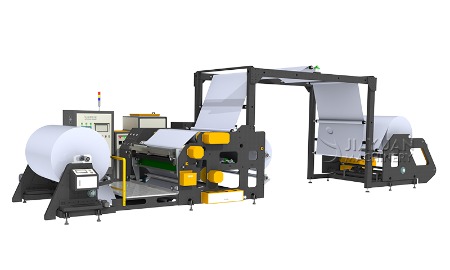
Adhesive coating machine
A hybrid approach is the use of UV-curable PSAs, which are solvent-free liquids that polymerize upon UV exposure. These systems combine the environmental benefits of hot-melt with the performance of crosslinked acrylics. UV-PSA coaters include a UV lamp bank (usually LED) immediately after the coating head. The cure is instantaneous, allowing very high speeds. However, the adhesive formulation must be carefully balanced to avoid oxygen inhibition, and the UV intensity must be uniform across the width. These machines are still niche but growing in electronics and optical applications. For all PSA types, the substrate preparation—corona, flame, or chemical primer—is often integrated. Corona treaters use high-frequency discharge to raise surface energy, while flame treaters are used for paper. Primer coating stations may be added before the main PSA coating for difficult substrates like polyolefins.
Machine control architecture differs among these systems. Solvent-based lines have complex safety interlocks: if LEL exceeds 25%, the line automatically shuts down and vents. Water-based lines focus on humidity control and drying efficiency. Hot-melt lines emphasize temperature stability and melt pressure control. Modern
PSA coating machines use a central PLC with HMI that provides graphical interfaces for setting parameters, storing recipes, and generating reports. Remote diagnostics are common, allowing the supplier to troubleshoot from a distance. The choice of pump is also system-dependent: solvent-based use stainless steel gear pumps; water-based use diaphragm or progressive cavity pumps; hot-melt use heated gear pumps with tight clearance. All pumps require regular calibration and seal replacement. Furthermore, filtration is crucial to prevent gels—for solvent-based, multi-bag filters; for hot-melt, screen changers with melt filtration.
Maintenance protocols vary accordingly. Solvent-based machines need regular inspection of seals, gaskets, and solvent recovery carbon beds. Water-based machines require thorough rinsing after each batch to prevent bacterial growth and film formation. Hot-melt machines need periodic cleaning of the melter and die to remove charred polymer, using specialized flushing compounds. UV systems need lamp reflector cleaning and power calibration. Operational costs also differ: solvent-based have high solvent consumption and recovery energy; water-based have higher drying energy; hot-melt have lower overall energy but higher raw material cost. Manufacturers must choose based on product performance requirements, environmental regulations, and cost targets. In many cases, a single coating line may be designed with interchangeable heads and oven configurations to switch between water-based and solvent-based, though this adds complexity. Ultimately, the PSA coating machine is a versatile platform that must adapt to the specific adhesive chemistry, and understanding these distinctions is key to optimizing production efficiency and product quality.